
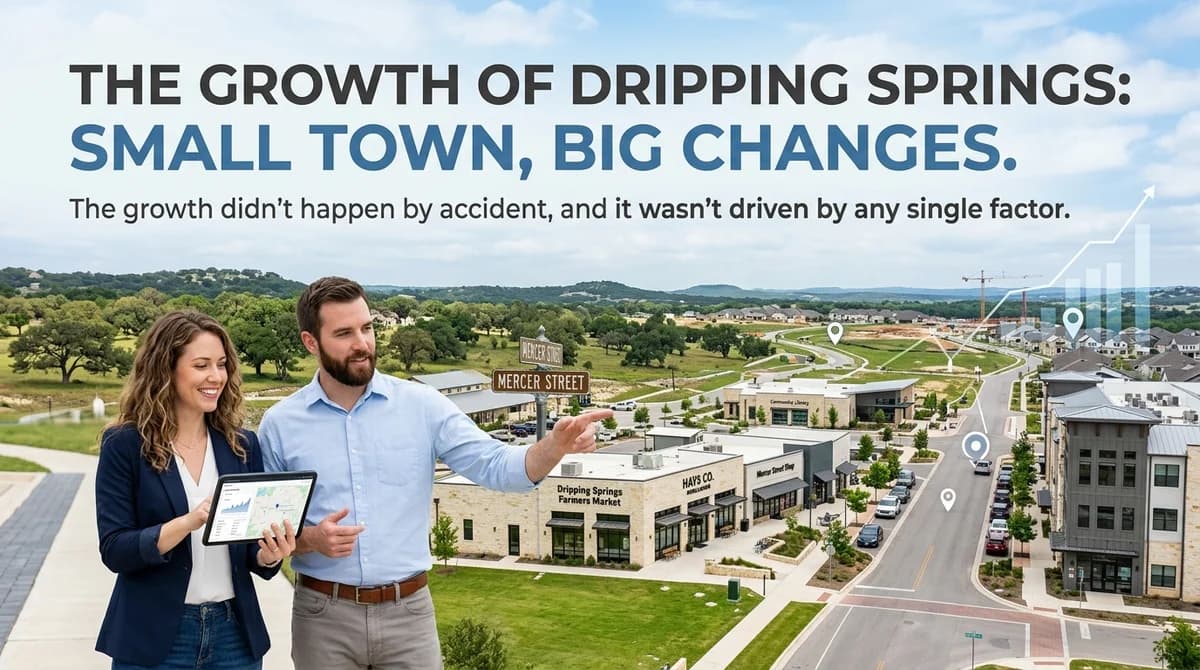
In 2000, Dripping Springs, Texas was a small Hill Country town of about 1,500 people, known mostly to locals and the occasional antique hunter passing through on US-290. By 2024, the city's population had surpassed 10,000 — a growth rate of more than 550% in a single generation. And the broader community of Dripping Springs, including the unincorporated areas spreading across the surrounding Hill Country, has grown even more dramatically.
It is, by any measure, one of the most remarkable growth stories in Central Texas. And Central Texas has no shortage of remarkable growth stories.
The question worth asking — for newcomers trying to understand the place they've moved to, for longtime residents trying to make sense of what their town is becoming, and for anyone curious about the forces shaping Texas's fastest-growing regions — is how this happened, what it means, and where Dripping Springs goes from here.
Why Dripping Springs Grew
The growth didn't happen by accident, and it wasn't driven by any single factor. It was the convergence of several trends that, when they met in one place, produced something close to a perfect storm of suburban expansion.
The Austin overflow. Austin has been one of the fastest-growing large cities in America for years. As home prices in Austin rose — dramatically and repeatedly — families and remote workers who wanted proximity to the city without urban prices looked west along the US-290 corridor. Dripping Springs, 25 miles out, offered what Austin couldn't: space, beauty, lower price points, and the Hill Country landscape that people romanticize about Texas.
The school district. Dripping Springs ISD has a reputation as one of the top school districts in Texas, and it's earned that reputation through consistent performance, strong fine arts and athletics programs, and a community culture that values education. Families who prioritize school quality were — and are — willing to commute longer distances and pay more for housing to land in the Dripping Springs school district. The schools weren't just a consequence of the community that formed here; they were a cause of the community that formed here.
Remote work. The shift to remote and hybrid work accelerated what was already happening. When workers stopped needing to be in Austin five days a week, the calculation changed dramatically. Living 25 miles from the city and only commuting twice a week — or never — transformed Dripping Springs from a distant suburb into a genuinely viable primary residence for a much larger population.
The Hill Country brand. "Hill Country" carries enormous positive associations in Texas, and Dripping Springs has benefited from proximity to that brand. The wildflowers, the wineries, the distilleries, the outdoor recreation, the wedding venues — all of it contributes to an identity that feels aspirational. People want to live somewhere that sounds like a vacation destination, and Dripping Springs increasingly fits that description.
National and international in-migration. Texas's broader growth has brought significant numbers of people from California, New York, Colorado, and other high-cost-of-living states who are attracted by the absence of state income tax, the relative real estate affordability (by their standards), and the quality of life. These newcomers, often earning high incomes and able to work remotely, have driven demand at price points that local longtime residents couldn't have anticipated.
The Numbers
The statistics tell a striking story. Dripping Springs's city population grew from roughly 1,500 in 2000 to about 10,000 by 2024 — the 556% growth figure that appears in census and demographic data. But those numbers only capture people within the city limits, which in Dripping Springs is a relatively small geographic area.
The broader Dripping Springs community — including the master-planned subdivisions and rural residential developments in the extraterritorial jurisdiction (ETJ) of Dripping Springs and surrounding Hays County — is considerably larger and growing even faster. Over 8,000 new residential lots have been permitted in the city and its ETJ. That number represents thousands of additional families on their way, even beyond those already counted.
The median household income in Dripping Springs is approximately $106,000 — about 40% higher than the Texas median — reflecting the profile of the newcomers driving growth. The community that has formed around this rapid expansion is generally affluent, educated, and employed in industries that increasingly allow location flexibility.
What Changed: The Benefits
Growth has brought real improvements that make Dripping Springs a better place to live in concrete ways.
Retail and dining. The town that once had limited shopping and dining options now has an H-E-B (Texas's beloved grocery institution), a growing commercial corridor along US-290, and a restaurant scene that includes genuine culinary talent. The craft beverage industry — the distilleries, breweries, and wineries that now define Dripping Springs's identity — grew in large part because the market of affluent, experience-seeking residents was there to support it.
Community infrastructure. New parks, trail systems, and community facilities have been built or improved as the tax base has expanded. The city has invested in infrastructure that supports the community gathering and outdoor culture that defines life here.
Economic vitality. The growth has created economic opportunity that simply didn't exist before. Local businesses, service providers, and entrepreneurs have a market that didn't exist in any meaningful form 20 years ago. The wedding industry alone represents hundreds of millions of dollars in economic activity.
The event calendar. Founders Day now draws tens of thousands of people. The Songwriters Festival has become a regional music destination. Western Wonderland has grown into a beloved Hill Country holiday tradition. These events exist at their current scale because the community has the density to support them.
What Changed: The Challenges
Growth is never purely positive, and Dripping Springs's rapid expansion has created real tensions and challenges that residents navigate daily.
Traffic. US-290 between Dripping Springs and Austin is increasingly congested during peak commute times. The growth that has filled the corridor with residents has outpaced the road infrastructure's ability to handle the volume. For many residents, the daily commute has become a significant quality-of-life issue — one of the clearest trade-offs between the rural setting they came for and the suburban reality they now inhabit.
Water. The Edwards Aquifer, the Hill Country's primary water source, is a finite resource. Rapid residential development raises real questions about long-term water availability and the sustainability of the aquifer system that supports both the existing community and the natural landscape. Water rights, water conservation, and water infrastructure are ongoing concerns that local government and regional water authorities are actively working to address — with varying degrees of success and urgency.
Affordability. The growth that has benefited many longtime property owners has also made housing increasingly unaffordable for service workers, teachers, firefighters, and others who make the community function. The median home price in Dripping Springs is significantly higher than it was a decade ago, and the gap between the incomes of newcomers and the incomes of people who work in the local service economy has widened. This is a challenge that virtually every rapidly growing Texas community faces, and Dripping Springs is no exception.
Character and identity. This one is harder to quantify but matters enormously to longtime residents. The Dripping Springs that existed 20 years ago — small, quiet, known mostly to people who sought it out — no longer exists in the same form. Master-planned subdivisions with thousands of homes, big-box retail along US-290, and traffic that makes the downtown feel less accessible have all changed the texture of the place. The question of whether Dripping Springs can preserve the character that attracted people in the first place, even as growth transforms its physical reality, is one that community leaders, longtime residents, and thoughtful newcomers wrestle with regularly.
The Shape of What's Coming
The growth trajectory of Dripping Springs shows no signs of reversing. The 8,000-plus permitted residential lots represent a pipeline of development that will continue to bring new residents for years. Austin's continued growth will keep pushing people westward along the 290 corridor. And the factors that made Dripping Springs attractive in the first place — the schools, the Hill Country setting, the proximity to Austin, the community culture — continue to drive demand.
What will determine Dripping Springs's long-term character isn't whether it grows, but how it manages that growth. The decisions being made right now by local government about land use, water conservation, transportation infrastructure, and community investment will shape what Dripping Springs looks and feels like in 2040.
Those decisions are being made by real people — elected officials, planning commissioners, school board members, and ordinary citizens who show up to meetings and make their voices heard. The community's ability to channel its growth toward outcomes that preserve what makes Dripping Springs worth living in is perhaps the defining challenge of the current moment.
A Place at a Crossroads
There's a version of Dripping Springs's future that looks like dozens of other fast-growing Texas suburbs: miles of master-planned development, traffic that makes the Hill Country inaccessible, and a sense of place that's been largely consumed by the growth that was meant to celebrate it.
There's another version that looks like a community that grew thoughtfully — preserving its natural resources, investing in infrastructure, maintaining the character of its historic core, and building a quality of life that reflects the values that attracted people here in the first place.
Which version wins is still very much an open question. What's certain is that the decisions being made right now matter enormously, and that the people of Dripping Springs are not passive in the face of them. The same independence of spirit that makes this community distinctive is also, maybe, its best asset for navigating the growth that's reshaping it.
It's a town worth paying attention to — not just as a destination, but as an example of what happens when America's relentless growth impulse meets a place that people genuinely love and want to preserve.