
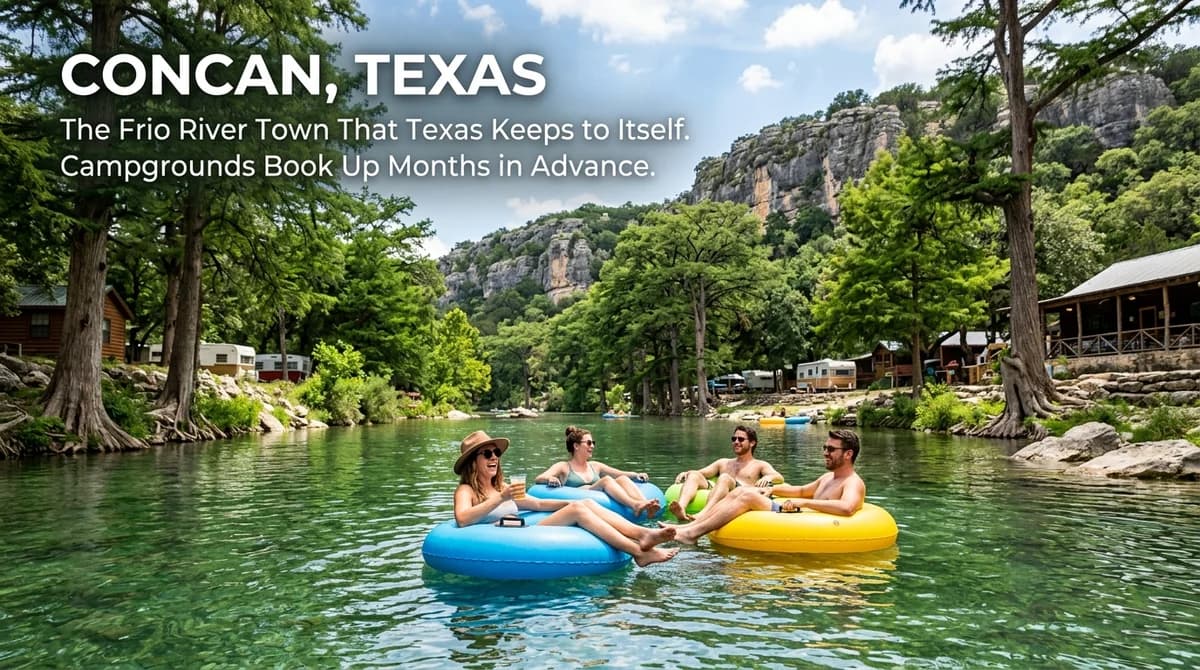
There's a name that circulates among Texans who know the Hill Country well, spoken with a kind of quiet satisfaction that comes with knowing something good before the rest of the world figures it out. That name is Concan. And for the better part of a century, generations of Texas families have been making the drive south from San Antonio, west from Austin, up from the Rio Grande Valley, and arriving at the same stretch of clear, cold river feeling like they've found something that belongs to them.
They're not entirely wrong. Concan isn't a secret — the campgrounds book up months in advance and summer weekends bring significant crowds — but it occupies a different place in the cultural consciousness than the Hill Country's more prominent destinations. Fredericksburg gets the wine tourists. New Braunfels gets the tubing crowds with a highway full of chain restaurants. The Frio River gets the Texas families who found it decades ago and have been coming back every summer since.
Where Concan Is
Concan is an unincorporated community in Uvalde County, tucked into the Frio Canyon about 90 miles west of San Antonio. It's not a town in any formal sense — there's no city hall, no downtown square, no stoplight. What Concan has is a stretch of the Frio River, Garner State Park at its northern edge, a concentration of lodges and cabin resorts along the water, a handful of small restaurants and outfitters, and the particular atmosphere of a place that was built for one purpose and does that purpose exceptionally well.
The drive from San Antonio takes roughly 90 minutes via US-90 West through Hondo and then north on US-83 toward Leakey, through terrain that transitions gradually from South Texas ranch land into the limestone bluffs and cedar-covered hills of the Hill Country. The last 30 minutes of the drive, as the road follows the Frio Canyon north from Uvalde through increasingly dramatic limestone scenery, is worth doing slowly. By the time you arrive at the river, the landscape has already done most of the work of making you feel like you've left the city behind.
The Frio River
The word "frio" means cold in Spanish, and the Frio River earns its name. Fed by springs that emerge from the Edwards Plateau limestone, the river runs at a consistent chill — cold enough to be genuinely refreshing in a Texas summer, cold enough to make you catch your breath when you wade in from a 100-degree bank. On a July afternoon when the temperature in San Antonio is near triple digits, that cold river is exactly what every Texas summer has been quietly promising.
The Frio is not a big river. In its normal late-summer flow, it's shallow in many sections, running over smooth limestone bedrock and gravel bars, with deeper pools at the bends and beneath the larger cypress trees. The water clarity is remarkable — in the clear pools, you can see the bottom in detail, watch fish move through the current, and observe the patterns of rock and sand that shift with each flood season. It's the clarity of spring-fed Hill Country water, not the murky brown of a rain-fed plains river.
The banks of the Frio are lined with bald cypress trees that are among the most distinctive features of the river corridor. These aren't young trees — some are genuinely old, their massive trunks wrapped in bark that tells decades of flood and drought, their "knees" poking up through the shallow water in the patterns that make a cypress creek one of the most visually distinct landscapes in Texas. In summer the cypress canopy shades the most popular swimming and tubing areas, keeping the water temperature and the air temperature a few degrees lower than the open sun of the surrounding hills.
What People Come Here For
The Frio River corridor near Concan has been a summer destination for Texas families since the early 20th century, and the activities that bring people here have remained remarkably constant across generations.
Tubing and swimming are the anchors. The Frio's limestone bedrock, relatively calm current (in normal conditions), and cold clear water make it ideal for floating on a tube for a few hours or simply finding a swimming hole and spending the day in and out of the water. Several outfitters along the river road and near Garner State Park rent tubes, kayaks, and canoes by the hour or day.
Garner State Park is one of the most popular state parks in Texas — consistently among the top parks in the system by visitation — and it forms the northern anchor of the Concan experience. The park has camping, cabins, river access, 16 miles of hiking trails including the famous climb to Old Baldy, and a tradition of summer jukebox dances that has been going on since the 1940s. If you're visiting Concan and you haven't experienced Garner, you haven't had the full Frio experience.
Neal's Lodges, founded in 1926, is the original and most iconic lodging on the Frio, a family operation that has been hosting Texas summer visitors for nearly a century. The 71 cabins, tent sites, and RV hookups along the river, plus the Neal's Dining Room across the road, represent a specific kind of Texas summer tradition that has been passed down from parents to children to grandchildren across multiple generations.
Fishing for largemouth bass, Guadalupe bass, catfish, and sunfish draws a quieter contingent of visitors who come for the river's natural quality rather than the summer crowd energy. The cold, clear Frio supports healthy fish populations, and the deeper pools and slower sections offer productive fishing for those who know where to look.
Wildlife watching rewards the observant visitor more than most people expect. The Frio Canyon is in the heart of the Texas Hill Country, one of the birding hotspots of North America. The golden-cheeked warbler and black-capped vireo — both endangered species — nest in the mature Ashe juniper woodlands of the surrounding hills. The Frio Bat Cave, a short drive from the main river area, houses 12 million Mexican free-tailed bats that emerge each evening in a spectacle that's one of the more extraordinary wildlife experiences in Texas.
The Rhythm of a Frio Trip
There's a particular rhythm to a Frio River vacation that repeat visitors come to love and first-timers often discover with some surprise.
You wake up before the heat builds and walk to the river while the cypress trees are still in morning shadow, the water cold and the light filtering through the leaves in a way that makes the whole canyon feel different from what it'll be in three hours. You float for a while, find a good rock to sit on, watch the fish.
The middle of the day is for the water or the shade. You eat when you're hungry — at the camp kitchen, at Neal's Dining Room, at whatever cabin porch has the best afternoon light. You don't rush anywhere because there isn't anywhere to rush.
Late afternoon, if you're at Garner, you might hike up Old Baldy for the views across the canyon before the sun gets low. In summer, you plan around the jukebox dance at the park's concession building — a genuine multi-generational event where kids, parents, and grandparents all end up on the same dance floor as the evening cools.
Night falls, and the stars appear over the canyon walls with the clarity that only comes from being two hours from the nearest city. The Frio Canyon at night is very quiet and very dark, and that specific quality of stillness is part of what people are chasing when they make the drive out here.
Getting the Most Out of Your Visit
Book everything early. Garner State Park camping reservations open months in advance and sell out for summer weekends almost immediately. The best cabins at Neal's and the major resorts fill up on similar timelines. If you're planning a summer trip, the planning horizon is measured in months, not weeks.
Consider shoulder seasons. The Frio in spring (March through May) and fall (September through November) is less crowded, equally beautiful, and in some ways more pleasant than midsummer. The river is still cold, the cypress trees are either budding or turning gold, and the crowds have significantly thinned. A Frio trip in October, when the mornings are crisp and the afternoon light is golden and the river practically belongs to you, is one of those experiences that makes you feel like you've beaten the system.
The drive matters. Don't rush through Uvalde or past the canyon approach. Stop at the overlooks on US-83. Uvalde has a genuinely pleasant town square worth a meal before or after your stay. The landscape between San Antonio and Concan is part of the Texas experience, not just the commute to it.
Pack for self-sufficiency. The Concan area does not have a big grocery store, a pharmacy, or a hardware store. The nearest H-E-B is in Uvalde, about 30 miles south. Make your supply run before you arrive or budget time for the Uvalde trip.
Concan isn't a destination that needs much explaining once you've been there. The river does the explaining. Cold, clear, shaded by old cypress trees, running through a limestone canyon under a sky big enough to fill your whole field of vision — it's the Texas summer at its most essential, and it's been waiting for you every year since before you were born.