
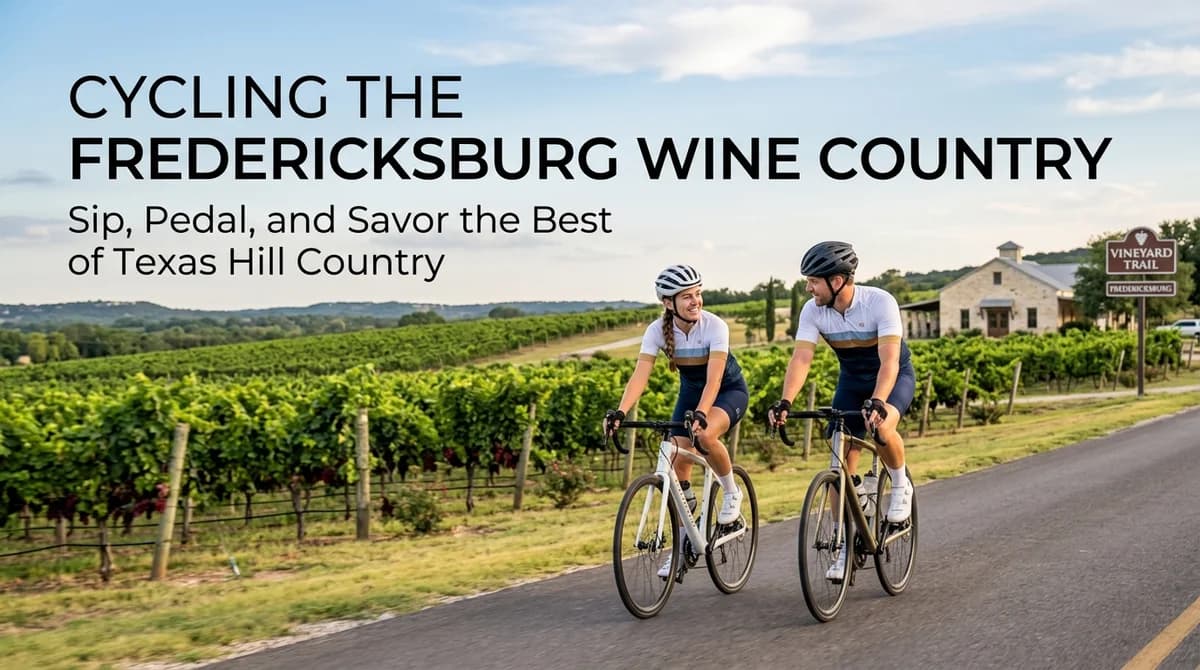
Cycling the Fredericksburg Wine Country
There is a version of the Fredericksburg wine trail experience that happens at car speed — a series of tasting room stops connected by a few miles of US-290, each visit blending into the next until the afternoon is over and you have several bottles in the back seat. It's a perfectly good way to spend a day in the Hill Country.
And then there is the cycling version, where the wineries are still there but the road between them is lived in rather than passed through — the limestone cuts and cedar-covered hills visible at a pace that lets you actually see them, the climbs earning the views, the tasting rooms arriving as genuine destinations after real effort. Fredericksburg has been developing a reputation as one of the better cycling destinations in Texas for good reason: the back roads of Gillespie County provide exactly the combination of scenic terrain, manageable traffic, and route variety that makes a place genuinely worth pedaling through.
Why Fredericksburg Works for Cycling
The back roads of Gillespie County are among the most cyclist-friendly in the Texas Hill Country. The traffic on the county roads and ranch roads that web through the terrain between the wineries is light to nonexistent outside of peak tourist weekends, the road surfaces are generally well-maintained, and the terrain — while genuinely hilly — has the kind of climbing that rewards effort with views rather than the grinding, relentless grades that make some Hill Country areas discouraging for recreational riders.
The wine trail structure creates natural waypoints. The density of tasting rooms along and off US-290 and the surrounding roads means that a cycling route through the wine country can incorporate planned stops at destinations rather than just riding point-to-point through scenery. A 30-mile loop with three or four winery stops, arriving at each under your own power, is a qualitatively different wine country experience than the same stops by car.
Fredericksburg has been recognized as a cycling destination by national cycling media, and the infrastructure — two quality bike shops, a community of regular riders who lead weekly group rides, and a growing awareness among local businesses of the cycling visitor market — reflects that recognition.
Key Routes
The Willow City Loop (13–55 miles depending on configuration)
The Willow City Loop itself is 13 miles, but cyclists typically combine it with the approach from Fredericksburg via Highway 16 (about 13 miles each way) to create a 39-mile circuit from town. Extended versions that loop through the surrounding county roads can push the distance to 55 miles or more.
The loop has five notable climbs, with the Willow City Ledge — the most demanding ascent on the loop — being the point where the terrain separates casual riders from those who came prepared. The descent on the far side rewards the climb with views across the granite country that make the effort feel warranted.
The combination of the Hill Country terrain and the wildflower displays in spring makes the Willow City Loop one of the most visually spectacular cycling routes in Texas during the March–April window. The same caveat that applies to driving the loop applies to cycling: weekday rides avoid the traffic congestion that spring weekend tourist volumes create on the loop's narrow roads.
Level: Moderate to challenging. The climbs are real and the route distance from town is substantial. Fit recreational riders will find it manageable; casual cyclists may want to drive to the loop trailhead rather than riding from town.
The Espresso Route (24 miles)
A shorter, more accessible route that uses Old Mason Road as its primary corridor — a long, relatively flat stretch of ranch road that connects to the Promised Land Loop in the middle of the route for a scenic and technically interesting detour. Total climbing is approximately 1,100 feet over 24 miles, with grades that are consistent rather than brutally steep.
The Espresso is the route that works best for intermediate riders who want a satisfying Hill Country cycling experience without committing to the longer distances of the Willow City configuration. It covers beautiful terrain and can be completed in two to three hours at a comfortable pace.
Level: Moderate. Accessible to recreational cyclists who are comfortable with rolling terrain.
The Wine Road Loop (15–25 miles, variable)
The most direct cycling connection to the winery experience, using the combination of US-290 and the ranch roads that parallel and cross the main wine trail corridor. The challenge of cycling US-290 itself — a two-lane highway with significant tourist traffic on weekends — is real, and the better approach is to use the ranch roads that run parallel to the highway and cut across to specific winery destinations rather than riding the highway directly.
Several tour operators and local cycling guides have developed specific wine road cycling routes that use the less-trafficked roads for the connecting sections and the wineries as natural stops. The Visit Fredericksburg website and the local bike shops can provide current route recommendations that account for road conditions and traffic patterns.
Level: Easy to moderate, depending on specific route configuration. The terrain between the wineries is rolling but manageable.
The FGB 103 (103 miles)
For experienced cyclists who want a full day in the saddle, the FGB 103 is a century-length loop that starts in Fredericksburg and winds through the Hill Country, passing through Luckenbach, Sistervale, Waring, and Comfort before returning to town. The 103-mile route covers the full range of Gillespie County and surrounding terrain, with cumulative climbing that makes it a genuine endurance challenge.
The FGB 103 is the route that puts Fredericksburg's cycling credentials in perspective — a century loop that could stand alongside cycling routes in destinations with established cycling tourism, routed through terrain that most visitors don't see because they never leave the US-290 corridor.
Level: Advanced. This is a serious distance ride for experienced cyclists with appropriate preparation.
Local Resources
Hill Country Bicycle Works is one of the two primary bike shops in Fredericksburg, with rentals, sales, repairs, and local route knowledge. The shop hosts a Friday morning group ride — the 8am no-one-left-behind ride starting at Marktplatz — that welcomes visiting riders and covers a steady workout route with regroup stops.
Jack and Adam's Bicycles of Fredericksburg, located in the Warehouse District, offers a similar range of services along with a Saturday morning group ride at 9am from the shop. The rides are beginner-friendly in the sense that no one is left behind, while the terrain provides enough challenge that experienced riders find them worthwhile.
Ranch Road One Bike Rentals provides guided tours of the wine country by bicycle, combining rental equipment with route knowledge and the wine trail stops that make the experience coherent for visitors who don't want to plan their own route.
The Cycling Coop is another local operation offering cycling experiences in the Hill Country terrain around Fredericksburg.
Practical Advice
Timing by season: Spring and fall are the best cycling seasons — mild temperatures, good road conditions, and the best scenery. Summer cycling in Fredericksburg requires very early starts (before 7am) to complete meaningful distances before the heat becomes prohibitive. The Texas summer afternoon is not the time to be on an exposed limestone ridge on a bike.
Winery stop logistics: Cycling to a tasting room has a practical dimension that driving doesn't — you can't carry six bottles back on a bike, and tasting affects your riding capacity. Most winery-cycling experiences work best with a designated support vehicle, a cycling tour company that handles transportation, or a strategic limit on actual tasting intake at each stop. Many tasting rooms will hold purchased bottles for later pickup if you're cycling.
Traffic awareness on US-290: The main wine trail highway carries significant tourist traffic, particularly on weekends. The ranch roads that parallel it are safer and more pleasant for cycling. Use US-290 only where necessary and opt for the parallel routes whenever possible.
Water and food: The distances between service stops on the back roads can be significant. Carry more water than you think you need — 24–32 ounces per hour in warm weather — and bring food for rides over 2 hours. The wineries along the route have food options at many locations, but don't rely on them as your only nutrition source on a long ride.
Fredericksburg wine country by bicycle rewards the extra effort it requires. The road between the wineries is, in some ways, better than the wineries themselves — and arriving somewhere by your own power always makes it taste better.