
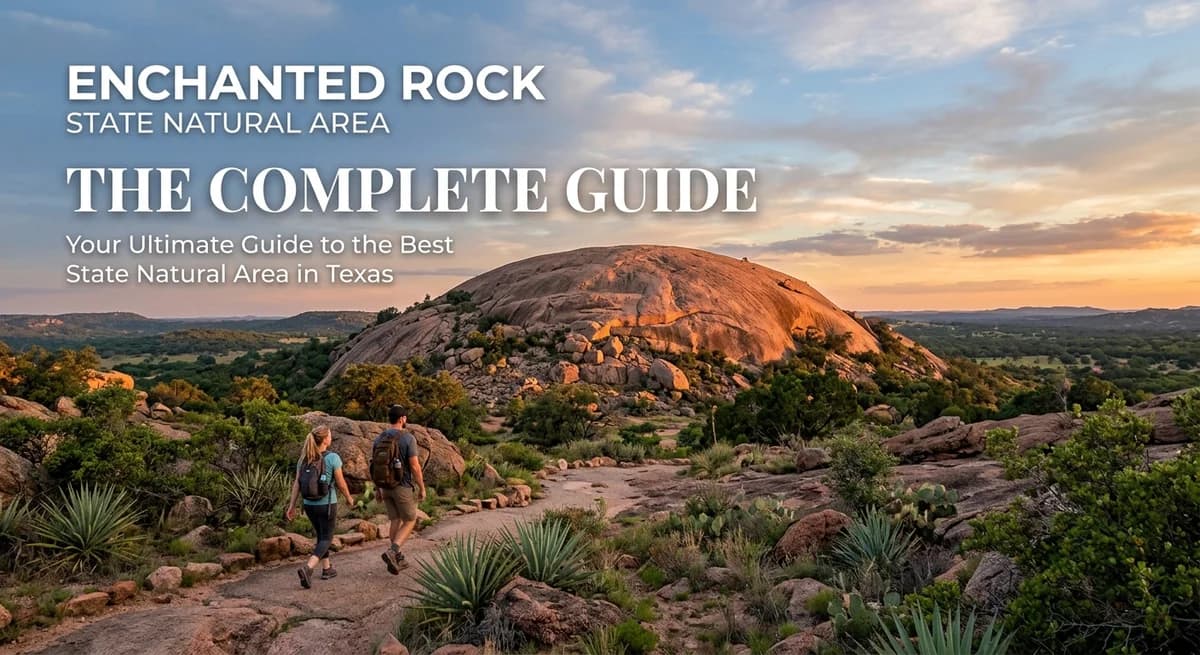
Seventeen miles north of Fredericksburg on Ranch Road 965, a dome of pink granite rises 425 feet above the surrounding Hill Country terrain. Enchanted Rock is visible from miles away on the approach — a bare, rounded mass of stone against the sky that looks unlike anything else in the Texas landscape. It's not a mountain. It's not a cliff. It's something the geology textbooks call a batholith — a massive intrusion of igneous rock that crystallized deep in the earth over a billion years ago and was gradually exposed by hundreds of millions of years of erosion. What's visible above ground today is the top of a structure that extends much deeper into the earth.
The Comanche and Tonkawa people who lived in this part of Texas attributed supernatural significance to the rock — the groaning and cracking sounds it makes as it heats and cools with the day's temperature changes, the ghost fires that sometimes appear on its surface (a natural phenomenon caused by dew-wet lichen catching starlight), and its sheer visual dominance of the surrounding landscape gave the dome a spiritual character that the Spanish heard about and recorded as "Enchanted Rock" in their colonial documents.
For the three-quarters of a million visitors who come here each year, it's the best state natural area in Texas. Understanding how to experience it well — when to come, which trails to take, how to handle the reservation system — is what this guide is for.
The Reservation System: What You Need to Know First
Enchanted Rock is one of the most popular day-use destinations in the Texas State Parks system, and it reaches capacity on most weekends and many weekdays from spring through fall. The Texas State Parks online reservation system (texas.reserveamerica.com) allows day-use pass reservations up to one month in advance.
Book your day-use pass in advance. This is not optional advice for spring and fall weekends — it's the difference between getting in and driving 45 minutes home without seeing the rock. Passes open exactly one month ahead, and popular weekends sell out within hours of becoming available.
Day-use fees are $8 per adult; children 12 and under are free. The park opens at 6:30am and gates close at 8pm, with the park itself open until 10pm.
Morning entry slots are typically more available than midday. The 6:30–8:30am morning window gets you on the rock before the heat builds and before the crowds peak — arguably the best conditions the park offers in every season.
Walk-up availability exists on weekdays and shoulder-season weekends when the park hasn't reached capacity. Checking the reservation system the night before for any cancellations is worth the two minutes it takes.
The Summit Trail: The Centerpiece Experience
The Summit Trail is the reason most visitors come. The trail climbs 2.1 kilometers (about 1.3 miles) from the main parking area to the top of the granite dome, gaining roughly 425 feet in elevation on exposed slickrock. The climb is not technically difficult — there are no ropes or handholds required — but the combination of the incline, the exposed granite surface, and the Texas heat makes it more demanding than its short distance suggests.
The granite surface has enough natural texture to provide traction in dry conditions, but it becomes genuinely slick when wet. The Summit Trail closes in wet weather for safety reasons, and the park enforces this. Check conditions before you go if rain is in the forecast.
From the summit, the view extends across the Hill Country terrain in every direction — the rolling hills of Llano and Gillespie counties, the cedar and live oak woodland, the ranch country spreading to the horizon, and on clear days a sweep of the granite country that reveals how the Llano Uplift's pink granite extends across the landscape in patches. The summit is broad enough that multiple groups can spread out without feeling crowded, and spending 20–30 minutes at the top rather than immediately descending is the right pace.
Pets are not permitted on the Summit Trail or on the granite domes. They're allowed on the Loop Trail and in the campground and picnic areas.
The Other Trails
Enchanted Rock has nearly 11 miles of trails beyond the Summit, covering different aspects of the park's geology, ecology, and terrain:
The Loop Trail (4 miles) circumnavigates the main dome and the surrounding granite formations, passing through the cedar and live oak woodland, across granite outcrops, and along the seasonal drainage that runs through the park's lower areas. This is the park's most diverse trail — it provides the best views of the dome from multiple angles, passes through the more botanically interesting terrain where the transition between granite and soil supports a range of wildflowers in spring, and is accessible to a wider range of hikers than the steep summit route. Dogs on leash are permitted on the Loop Trail.
The Enchanted Rock Cave Area — several "caves" formed by exfoliation slabs (large sheets of granite that have separated from the main dome and leaned against it, creating sheltered spaces beneath) are accessible from the Loop Trail. These are not true caves in the geological sense but rather overhangs and sheltered spaces that maintain a lower temperature than the exposed rock above and that support a different community of organisms adapted to the shade and moisture.
Turkey Peak Trail and the trails connecting to the park's secondary granite formations — Sandy Creek, Little Rock, Freshman, and Bridge Mountains — extend the hiking options significantly for visitors who want more than the main dome. The park's 2025 expansion added over 3,000 acres, opening additional terrain that is being integrated into the trail system over time.
Camping at Enchanted Rock
Overnight camping at Enchanted Rock is tent-only — no RVs, pop-ups, or vehicle camping. The experience of camping here, waking up on the granite before the day visitors arrive, is qualitatively different from day use and worth planning for if you want the park at its most peaceful.
Backpacker campsites are walk-in only, distributed around the perimeter of the main dome and in the more remote sections of the park. The Moss Lake area (8 sites) and Walnut Springs (12 sites) require a 1–3 mile hike over rugged terrain to reach, which effectively ensures that only motivated visitors occupy them. Sleeping in the backcountry at Enchanted Rock, with the granite domes visible in the starlight and no road noise within earshot, is one of the better overnight experiences in the Texas state parks system.
Standard walk-in campsites are closer to the parking areas and accessible for campers who don't want a multi-mile carry to their site.
Camping reservations open through the same Texas State Parks system as day-use passes. Summer weekends book quickly; shoulder season and winter camping is more available.
Wildlife and Natural History
Enchanted Rock's combination of granite exfoliation habitat, seasonal pools (called "vernal pools" in the scientific literature), and the surrounding woodland supports a surprisingly diverse set of species adapted to life on and around exposed granite.
Vernal pools — shallow depressions in the granite surface that collect rainwater and support specialized aquatic communities between rains — are home to several species of fairy shrimp and other small invertebrates that have adapted to the boom-and-bust cycle of temporary water on rock. These pools are marked and protected within the park; walking through or disturbing them is prohibited.
Granite wildflowers — species adapted to the thin soil pockets on the granite surface — bloom in spring in the cracks and ledges where wind-deposited organic material has accumulated enough to support plant growth. The color of these blooms against the pink granite, particularly after a wet winter, is remarkable.
Birds are abundant throughout the park, with the combination of woodland, rock, and open terrain supporting both resident species and migrant visitors. The rock's exposed top attracts raptors — red-tailed hawks, American kestrels, and the occasional peregrine falcon — that use the thermal lift off the heated granite for soaring.
Enchanted Rock as an International Dark Sky Park
The park holds International Dark Sky Park certification — one of only two designated dark sky parks in the Fredericksburg area — which reflects the genuinely dark conditions that exist 17 miles north of a small city in a low-development part of Texas. The granite dome, with its unobstructed 360-degree horizon, is one of the better stargazing platforms in the region, and the park's late closing time (10pm) allows for after-dark visits to the summit during new moon periods.
Evening and night hikes to the summit during clear, moonless conditions produce Milky Way views across the granite and the surrounding Hill Country that daytime visitors never experience. The Summit Trail is open until 10pm (unlike most other trails), specifically to accommodate this use.
Practical Advice
Go in the morning. The combination of lower temperatures, fewer people, and the best photographic light all converge in the first two hours after the park opens. A 7am arrival puts you on the summit before 8am in conditions that afternoon visitors simply don't get.
Bring water. There is no water available on the summit trail or most of the rock. Texas heat and granite radiating stored thermal energy dehydrate faster than most people expect. Bring more than you think you need.
Wear appropriate footwear. The granite surface is rough and uneven. Hiking shoes or trail runners with grip are significantly more comfortable than sandals, especially on the descent where foot placement matters.
The shoulder seasons are best. Spring (March–May) and fall (September–November) combine comfortable temperatures with the best wildflower displays (spring) and the best photography light (fall). Summer visits are possible but require the earliest possible morning entry to beat the heat.
Plan around the reservation system. One month ahead, on the opening date, for any popular weekend. This is the only reliable strategy for guaranteed entry.
Enchanted Rock doesn't need embellishment. A billion years of geology and a clear Texas sky do the work. Go early, bring water, and give yourself time at the top.