
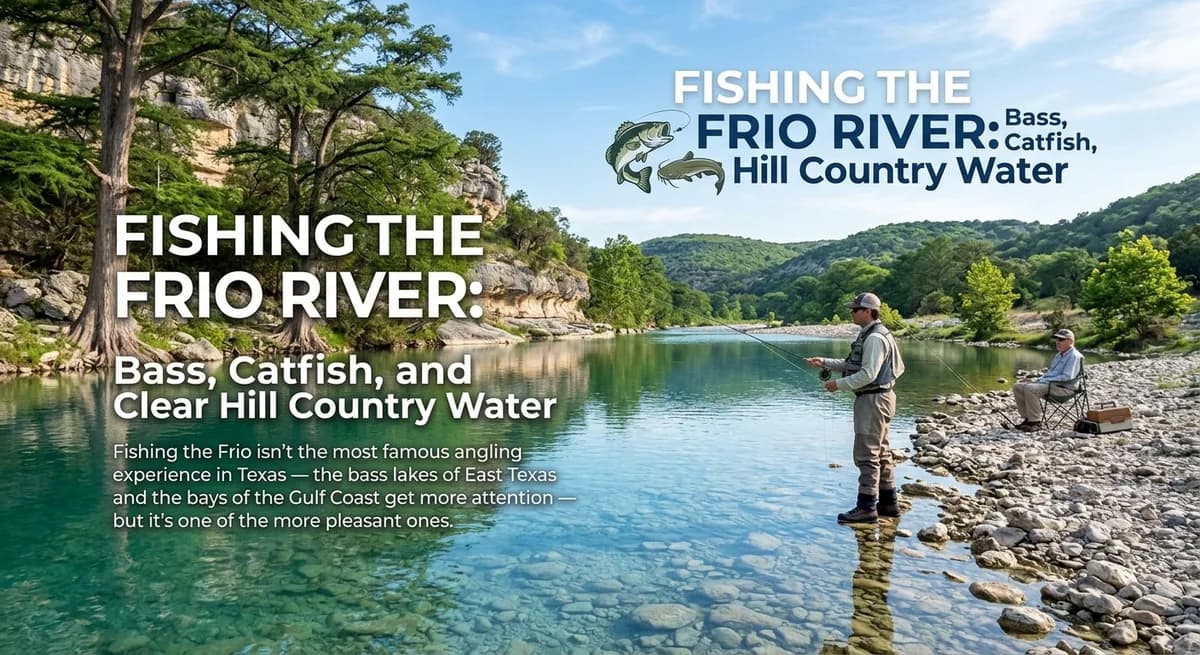
Most of the people who come to the Frio River come for the tubing, the swimming, the cold water on a hot day. A quieter contingent comes for the fishing. They arrive before the tube crowd is awake, they find their pools and their runs, and they spend the morning doing something that looks to passersby like simple relaxation but is actually a fairly skilled reading of water, weather, and fish behavior that has been refined by years of experience on exactly this kind of river.
Fishing the Frio isn't the most famous angling experience in Texas — the bass lakes of East Texas and the bays of the Gulf Coast get more attention — but it's one of the more pleasant ones, and the clear water of the Hill Country rivers provides a visual experience that most lake and reservoir fishing can't match. When you can watch a bass turn to investigate your lure in four feet of crystalline water, fishing becomes something more interesting than waiting for a tug on a line.
What Lives in the Frio
The Frio River supports a healthy and diverse fish population, with several species of particular interest to anglers:
Largemouth Bass are the dominant sport fish in the slower, deeper pools of the Frio. The limestone bluffs that drop directly into the water, the undercut banks, and the deeper runs below the riffles create the kind of structure that largemouth bass favor — cover, ambush positions, and access to the open water where they hunt. A well-presented lure along a limestone wall at first light is one of the most reliably productive presentations on the Frio.
Guadalupe Bass is the Texas state fish and a native of the Hill Country river systems, where it occupies the faster, cooler, more oxygenated water that its physiology is tuned for. The Guadalupe bass is smaller than largemouth — typically in the 8–12 inch range, rarely exceeding a pound — but it's a scrappy fighter for its size and a fish that requires more precise presentation than its slower-water cousins. Finding Guadalupe bass requires targeting the faster riffles and the aerated runs below rapids, where they hold in the current and ambush passing food.
Spotted Bass overlap with both the largemouth and Guadalupe bass in their habitat preferences and are present throughout the Frio system. They're often caught by anglers specifically targeting either of the other species.
Catfish — primarily channel catfish and flathead catfish — occupy the deeper pools and slower sections of the river, particularly the pools below the larger pools where the current deposits organic material and the larger fish hold in the deeper water. The Frio's catfish grow to significant size in the better pools, and the flathead catfish in particular can reach weights that surprise anglers expecting the more modest sizes typical of smaller Hill Country streams.
Sunfish — various species of bluegill, longear sunfish, and green sunfish — are present throughout the shallower sections of the river. They're not the target of most fishing trips to the Frio, but they're excellent for introducing young anglers to fishing because they're abundant, aggressive, and easy to catch on simple tackle.
When to Fish
Spring (March–May) is the most productive season for bass fishing on the Frio. Water levels are typically higher from winter rains, the fish are active as they move toward spawning condition, and the pre-spawn and spawn periods bring largemouth and Guadalupe bass into shallower water where they're more accessible to wading anglers. The mornings in spring are cool enough that the fish are active throughout the morning hours rather than retreating to deeper, cooler water as they do in summer's heat.
Fall (September–November) is the second peak season, as cooling water temperatures trigger increased feeding activity in the bass as they put on weight before winter. Fall fishing on the Frio can be excellent, the crowds have diminished from summer levels, and the combination of fall color in the cypress trees with active fish makes it one of the most satisfying seasons to be on the river with a rod.
Summer (June–August) is the most popular time for river visits but not the easiest time for fishing. The heat pushes fish into deeper, cooler sections of the river and reduces their daytime activity. The fishing crowds are also competing with tubing traffic on the most popular sections. Serious summer fishing happens in the early morning — before 9am, when the water is at its coolest daily temperature and before the tube launches start — and in the evening after the day's heat has begun to dissipate.
Winter (December–February) fishing on the Frio is a niche activity. The fish are present but cold and slow, feeding infrequently. Anglers who target winter bass typically use slow-moving presentations in the deepest pools, working lures through the fish's holding water with extreme patience. The reward is usually a fish that isn't particularly large, caught in conditions that require genuine commitment to appreciate.
Tackle and Techniques
For bass: Light to medium spinning or baitcasting tackle works well for Frio bass. The clear water demands lighter lines and more natural presentations than the murky reservoir environments where heavy tackle and big lures are standard.
Soft plastic worms and creature baits rigged Texas-style or on drop-shot rigs are reliable producers for largemouth in the limestone structure sections. Natural colors — green pumpkin, watermelon, brown — tend to outperform bright attractors in the clear water. Smaller profile lures in the 3–5 inch range are more appropriate for the Frio's bass than the large swimbaits and jigs that work in bigger, dirtier water.
For Guadalupe bass in the riffles, small in-line spinners, tiny crankbaits, and fly fishing with small streamers and dry flies are all effective. The Guadalupe bass is an excellent fly fishing target — aggressive, visible in the clear water, and positioned in the kind of flowing water that fly fishing is designed for.
For catfish: Natural baits are consistently the most productive approach for Frio catfish. Nightcrawlers, cut bait from the sunfish species that are easily caught in the river, chicken liver, and prepared catfish baits all work. Night fishing — targeting the catfish pools from an hour before dark until midnight — typically produces the largest fish, as flatheads in particular move during the dark hours.
Live bait for bass: Minnows and crawfish are native prey items in the Frio and produce reliably when rigged under a float or on a light drop rig. The crawfish in particular are abundant in the rocky shallows of the Frio and represent a primary food source for the river's bass.
Where to Fish
The pools below riffles are the primary structure in the Frio system. Every riffle — every section where the water shallows over limestone and speeds up — drops into a pool where the current slows and the depth increases. These transitions are where the fish concentrate: the bass holding at the head of the pool to ambush prey carried by the current, the catfish holding in the deeper water at the pool's center.
Limestone walls and undercut banks provide the ambush habitat that largemouth bass prefer. A lure worked along a rock face, dropping into the shadow of an undercut section, is presenting itself exactly where a largemouth would expect a small fish or crawfish to appear.
The shaded sections under cypress trees are reliable in summer, when the fish seek the cooler water in the shaded pools while the unshaded water warms in the afternoon sun.
Garner State Park's river section offers accessible fishing for day-use and camping visitors. The park's stretch of the Frio has been managed to maintain its natural character, and the fish population in the park reflects the quality of the water throughout the system.
Licenses and Regulations
Any angler 17 years or older fishing in Texas waters is required to have a valid Texas fishing license. Anglers 16 and under fish free. Licenses are available online through the Texas Parks & Wildlife website (tpwd.texas.gov), at sporting goods stores, and through the TPWD app.
Standard Texas freshwater fishing regulations apply to the Frio, including size and bag limits for bass species. Current regulations are published in the Texas Outdoor Annual available at tackle shops and online through TPWD.
The Quiet Pleasures of the Frio Fisherman
There's a version of the Frio experience that exists outside of summer peak hours — before the tube launches, after the last swimmers have left for the day, in the shoulder seasons when the river belongs to the people who came specifically for the river itself. Fishing is how you access that version.
Wade into the cold water at 6:30am when the cypress trees are still in full shadow and the fish haven't heard a splash in hours. Work a riffle carefully, watch the clear water for the subtle movement of a fish following your lure. Find a pool below a bluff and let a bait settle to the limestone bottom where the catfish hold overnight.
The Frio treats fishing well. The water is clear enough to make the experience visual — you're watching as much as you're fishing — and the fish populations are healthy enough that patience is rewarded. On the right morning, with the canyon to yourself and the water cold and clear around your knees, it's one of the better places to be in Texas, regardless of whether anything bites.