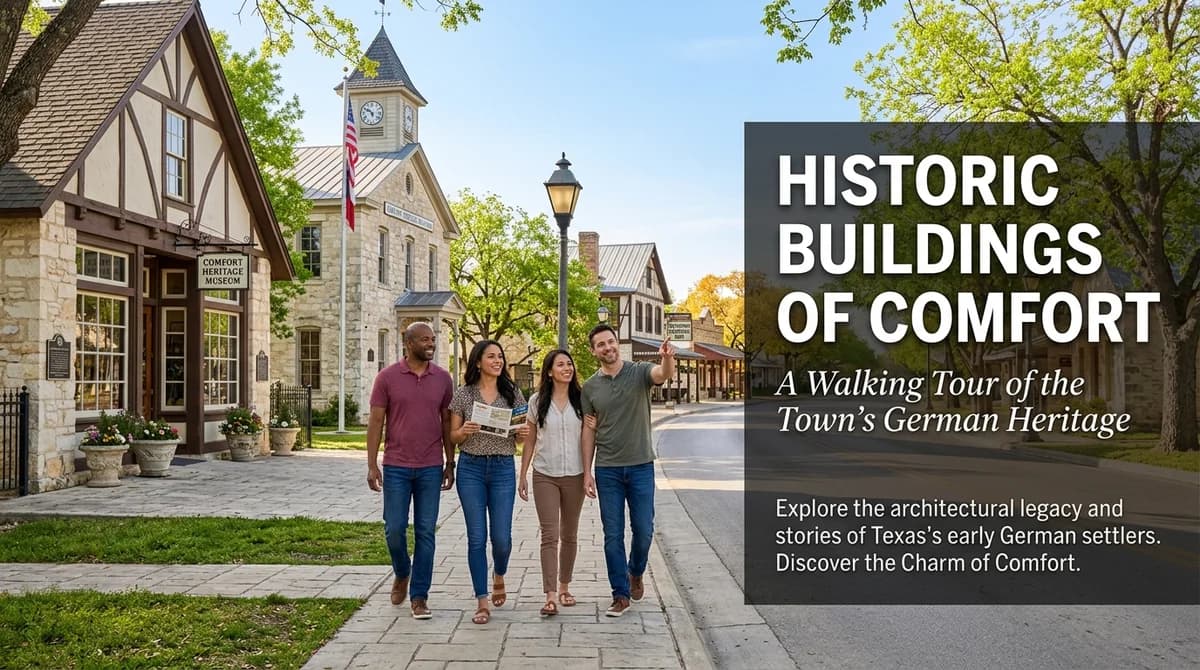
There are towns in Texas with a historic district, and then there's Comfort. Most historic districts are a handful of preserved buildings scattered among modern infill. Comfort is something rarer: an entire town center that looks almost exactly as it did in the late 1800s. With more than 100 buildings from the 19th century still standing and a National Historic District designation to show for it, Comfort offers one of the most authentic architectural experiences in the entire state.
The story behind those buildings is just as remarkable as the buildings themselves. When a group of German immigrants settled here in 1854, they brought with them a European tradition of careful, enduring construction. They quarried local limestone, developed their own building techniques suited to the Hill Country climate, and built structures that were meant to last centuries — and largely have.
This walking tour will guide you through the heart of Comfort's historic district, with context for what you're seeing and why it matters.
Before You Start: A Little History
Comfort was founded by a group of German immigrants known as Freethinkers — educated, politically progressive individuals who had fled the failed revolutions of 1848 in Europe. They were not a church-going community; Comfort was notably one of the few Texas towns of that era without a church for decades. Instead, they organized around a shared commitment to education, craftsmanship, and civic life.
Ernst Hermann Altgelt, a young German lawyer, laid out the town plan in 1854. The settlers he brought with him included carpenters, stonemasons, blacksmiths, and farmers — people with the practical skills to build a real community from scratch in the Texas wilderness.
The limestone they used came from local quarries and has proven remarkably durable. The thick walls — often two to three feet — provided natural insulation in Texas's brutal summers, while the stone's weight gave the buildings their distinctive, solid character. Today, walking through downtown Comfort, you're looking at architecture that is simultaneously functional and beautiful, a direct reflection of the people who built it.
The Walking Tour
This route can be completed in about 90 minutes at a leisurely pace, though you could easily stretch it to a full afternoon if you stop to browse shops and tasting rooms along the way. Start at the Treue der Union Monument on High Street and work outward from there.
Stop 1: The Treue der Union Monument (High Street at 3rd)
Begin your tour at the monument that defines Comfort's history more than any building. Erected in 1866, just four years after the Civil War's end, this simple obelisk honors the German Texans who refused to support the Confederacy — and paid for that loyalty with their lives. The inscription is in German: "Treue der Union," meaning "Loyalty to the Union."
It is the oldest Civil War monument in Texas and one of the only Unionist monuments ever erected in former Confederate territory. The story of the Nueces Massacre, in which Confederate troops ambushed and killed dozens of German Unionists fleeing through the Hill Country in August 1862, is a piece of Texas history that most people have never heard. This monument is where that story lives.
Stop 2: The Comfort Bank Building (High Street)
One of the most photographed buildings in town, the old Comfort Bank building exemplifies the vernacular limestone commercial architecture the Germans developed in the Hill Country. Its thick walls, narrow windows, and clean lines reflect a practical aesthetic that valued durability over ornamentation. Note how the limestone blocks are cut and fitted — the precision of the masonry speaks to the skill of the craftsmen who built it.
The building has housed various businesses over the years and today is part of the commercial fabric of High Street. But its bones are very much 19th century.
Stop 3: The Ingenhuett-Faust Hotel (High Street)
The Ingenhuett-Faust Hotel is one of the most storied structures in Comfort. Built in the 1880s, it served as a hotel, saloon, and general gathering place for the community for decades. Peter Joseph Ingenhuett, a German immigrant who became one of the most prominent merchants in the region, built it as a showcase of his success and the town's prosperity.
The building's limestone construction, broad covered porch, and arched windows are characteristic of the Hill Country German commercial style. It has gone through various incarnations over the years, and today portions of the building continue to function as commercial space. Standing in front of it, it's easy to imagine the stagecoach passengers and cattle drivers who once tied up their horses out front.
Stop 4: The Old Comfort Post Office
The old post office building is a good example of the slightly more formal civic architecture that the German settlers used for public buildings. Compared to the rough-and-ready commercial buildings, civic structures often feature more refined stonework and deliberate symmetry. This building anchored community life for generations as the hub of communication with the outside world.
Stop 5: The Bremer-Faltin Building
The Faltin family was one of the most influential in Comfort's history, and this building reflects their prominence. Friedrich Faltin and his descendants ran a general store here that served the region for decades, and the building's scale and quality of construction reflect the Faltins' ambitions for the town.
Like most buildings on this tour, it's built of local limestone with walls thick enough to keep the interior cool in summer. Notice the proportions — the high ceilings and generous windows were both aesthetic choices and practical ones, designed to maximize airflow in an era before air conditioning.
Stop 6: Camp Comfort / The Historic Gymnasium
Along Cypress Creek, you'll find Camp Comfort, which occupies a collection of historic structures including what is believed to be one of the oldest bowling alleys in Texas, dating to around 1860. The Germans who settled Comfort brought with them a love of organized leisure — bowling, gymnastics, and singing societies were central to their social life, and the buildings that housed these activities survive as evidence of that culture.
Camp Comfort today operates as a boutique bed and breakfast, but its historic structures are still very much intact. If you're not staying there, you can still appreciate the architecture from the outside and learn about its history from the signage on the property.
Stop 7: The Residential Streets
After covering the main commercial buildings, take a few minutes to walk down some of the residential side streets. The German settlers built their homes with the same care they brought to their commercial buildings, and many of those homes still stand today. You'll see limestone cottages with steep pitched roofs (adapted from European designs but modified for Texas weather), broad front porches, and simple, elegant proportions.
The residential architecture in Comfort doesn't get as much attention as the commercial buildings, but it's equally impressive as a record of how a community chose to live.
What to Notice As You Walk
The limestone itself. Hill Country limestone is a warm, golden-cream color that changes in the light throughout the day. Morning light and late afternoon light are particularly beautiful on these buildings. Notice how the stone has been cut in some places and left rougher in others — you can often read the era of construction from the masonry technique.
The rooflines. The German settlers adapted their rooflines to the Texas climate over time. Early buildings often have very steep roofs (echoing European style), while later buildings tend toward shallower pitches that work better in a hot climate.
The windows. In an era before air conditioning, window placement was critical. Notice how most buildings have windows positioned to catch prevailing breezes and draw air through the interior. This wasn't accidental — it was thoughtful design.
The scale. These buildings were built for permanence but not for grandeur. The German Freethinkers who settled Comfort weren't trying to impress; they were trying to build well. The result is an architecture that feels honest and grounded in a way that a lot of showier historic districts don't.
Practical Information
The historic district is always accessible for walking — you don't need a ticket or a reservation. Most of the buildings are private businesses or residences, so enjoy them from the street or sidewalk unless you're entering a shop or restaurant.
Walking tour maps are available at several shops along High Street. The Comfort Chamber of Commerce also has resources on the town's history available at their website and in person.
The best time to do the walking tour is mid-morning, before the heat of the day sets in. In the spring and fall, you can walk comfortably at almost any hour. In summer, aim for before 11am or after 4pm.
Wear comfortable shoes. The limestone sidewalks and streets are charming but uneven in places.
Allow yourself time to stop. The walking route itself is only about a mile, but the buildings deserve attention and the shops in between deserve browsing. Build in extra time to do the tour justice.
Why It Matters
Comfort's historic district is remarkable not just as a collection of old buildings, but as evidence of a community that built with intention and believed that what they created would outlast them. The German settlers were right. Nearly 175 years later, their limestone walls are still standing, still housing businesses, still sheltering people, still telling their story to anyone willing to walk these streets and look up.
That's not something you see everywhere. That's something worth making the trip for.