
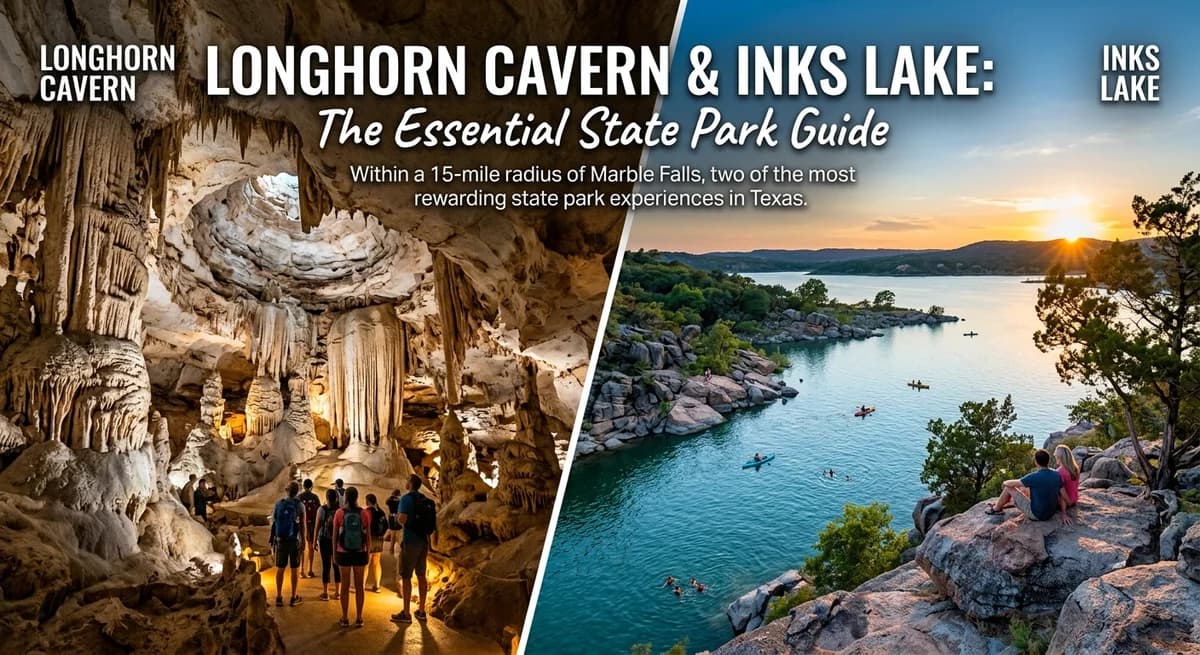
Within a 15-mile radius of Marble Falls, two of the most rewarding state park experiences in Texas sit practically side by side: Longhorn Cavern State Park and Inks Lake State Park. They are completely different from each other — one takes you underground through a geological marvel carved over millions of years, the other puts you on and around some of the most visually stunning lake water in the Hill Country — and together they make a day trip that's difficult to beat anywhere in Central Texas.
This guide covers both parks thoroughly, so you know exactly what to expect before you go and how to make the most of your visit.
Longhorn Cavern State Park
Address: 6211 Park Road 4 South, Burnet, TX 78611 Distance from Marble Falls: About 11 miles northwest via US-281 and Park Road 4 Entry: Admission is charged; Texas State Parks Pass accepted
What It Is
Longhorn Cavern is one of the most historically and geologically significant cave systems in Texas. The cavern's passages were carved by an underground river over millions of years — not by dripping water (like the stalactite-heavy caves you might picture), but by flowing water that dissolved the limestone from the inside out, creating smooth, wide passages with a distinctive, almost architectural quality.
The result is a cave that looks less like a fantasy landscape and more like a series of grand stone rooms — vaulted ceilings, smooth walls, and passages that invite you deeper without the tight squeezes of some cave systems. It's beautiful in a different way than a stalactite cave: more austere, more spatial, more focused on form and volume than on ornamental formations.
The History
The cavern's human history is as interesting as its geology. Native Americans used it for shelter for thousands of years. During the Civil War era, Confederate soldiers used a chamber as a gunpowder manufacturing site — the nitrate-rich bat guano that accumulated in the cave was processed into saltpeter for explosives. In the 1920s and 30s, a dance hall and restaurant operated inside the cavern, making it one of the more unusual entertainment venues in Texas history.
The entrance facilities were built by the Civilian Conservation Corps in the 1930s — the CCC's distinctive stone construction is still visible in the entry structures and amenities, adding a layer of Depression-era architectural history to the experience. The CCC's work at Longhorn Cavern is among the better-preserved examples of their construction in Texas, and it's worth slowing down to appreciate it before you head underground.
The Tours
Walking Tour (approximately 75 minutes): The standard guided tour covers about one mile of passages, following the ancient riverbed route through the cave's main chambers. The tour is interpretive and informative, covering the geology, history, and ecological significance of the cave with enough depth to be genuinely educational without losing the wonder of the experience. This is the right tour for most visitors, including families with older children.
Wild Cave Tour: For visitors who want something more adventurous, the Wild Cave Tour takes small groups into less-developed sections of the cave that require crawling, squeezing, and navigating by headlamp. This is a genuine spelunking experience that requires physical capability and tolerance for tight spaces — not for everyone, but for those who want it, an unforgettable adventure.
Practical Information
The cave maintains a constant temperature of about 64°F year-round, which makes it a welcome relief in summer but requires a light jacket in winter. Wear closed-toe shoes with good grip — the cave floor can be slippery. Photography is permitted and encouraged; the formations photograph beautifully with a smartphone in slow shutter mode.
Tours run on a set schedule; check the Texas Parks & Wildlife website for current tour times before you go. Reservations are recommended, particularly for weekends and during peak spring and summer season.
The park also has picnic areas and short surface trails that make it worth arriving a bit before your tour time to explore the grounds.
Inks Lake State Park
Address: 3630 Park Road 4 West, Burnet, TX 78611 Distance from Marble Falls: About 9 miles northwest via US-281 and Park Road 4 Entry: Day use fee; Texas State Parks Pass accepted
What It Is
Inks Lake State Park is what happens when a state parks system gets everything right. The park sits on the shores of Inks Lake — the smallest of the Highland Lakes at about 803 acres — but what Inks Lake lacks in size it more than compensates for in beauty and versatility. The combination of the lake's remarkably clear blue water, the pink and gray granite outcrops that line the shores and rise from the water, the cedar-covered hills behind them, and the Hill Country sky above creates one of the most visually striking settings in any Texas state park.
Texas Parks & Wildlife describes it well: "sparkling blue water, colorful rock outcrops, and striking sunsets." It's an accurate description that still somehow undersells what you actually see when you get there.
Activities
Swimming: Inks Lake has a designated swimming area that is simply one of the best swimming experiences in Texas. The water is clear, the bottom is granite and sandy, and the scenery makes every moment in the water feel like you're in a place that deserves to be famous. Day-use swimming is enormously popular in summer — arrive early or book in advance.
Kayaking and Paddleboarding: The park rents paddle boats, canoes, single and double kayaks, and stand-up paddleboards from the park store. The no-wake zone covering much of the lake makes it ideal for paddling without the interference of motorized boat traffic. Paddling along the granite shoreline and into the coves is the single activity that best captures what Inks Lake is about — allow at least two hours.
Rock Climbing and Bouldering: The pink granite outcrops that define the Inks Lake landscape also make it one of the few state parks in Texas with legitimate rock climbing. The routes are not extreme by climbing standards, but the location — climbing on ancient pink granite with a beautiful lake at your feet — makes it an experience that climbers of most ability levels will find rewarding.
Scuba Diving: Yes, scuba diving at a Texas state park. Inks Lake's clear water and interesting bottom structure (granite formations, submerged wood, aquatic vegetation) make it a legitimately good dive site. Divers need to have valid certification; check with the park about current visibility conditions before planning a dive trip.
Hiking: Nine miles of hiking trails wind through the park's terrain of shady cedar forests and across the dramatic rocky granite outcrops. Trail difficulty ranges from easy lakeside paths to more strenuous routes that climb to overlooks with views of the lake and surrounding Hill Country. The Devil's Waterhole area — a natural swimming hole surrounded by dramatic granite formations — is one of the most scenic spots on any trail in the park.
Fishing: Largemouth bass, catfish, and panfish are present throughout the lake. Fishing from the shore or from a kayak is accessible and productive. The park's smaller size and lower boat traffic compared to neighboring Lake LBJ makes for a more peaceful fishing experience.
Camping: Inks Lake has some of the most coveted camping spots in the Texas state parks system. All sites include at minimum water, a picnic table, and a fire ring. Many sites are directly on or near the lakeshore, making them among the most desirable waterfront camping spots in the Hill Country. Several sites have electrical hookups for RVs and campers who need power.
Camping reservations open 30 days in advance through the Texas State Parks system. Prime lakeshore sites and summer weekend dates book within minutes of becoming available. Set a reminder for your desired reservation date and be ready to book the moment the window opens.
Devil's Waterhole
The Devil's Waterhole deserves its own mention. This section of Inks Lake — accessible via a short hike from the park — is a series of swimming holes and natural pools carved into the pink granite, with clear water pooling in depressions worn smooth by millions of years of water movement. Cliff jumping from the granite into the pools below is a Inks Lake tradition that visitors self-regulate with reasonable caution. On a warm spring afternoon, with the Hill Country quiet around you and the pink stone warm under your feet, the Devil's Waterhole is one of those places that reminds you why Texas outdoor recreation is worth every bit of the reputation it has.
Visiting Both in One Day
The geographic proximity of Longhorn Cavern and Inks Lake — they're about four miles apart on Park Road 4 — makes combining them in a single day very practical and very rewarding. A natural rhythm:
Morning: Arrive at Longhorn Cavern for an early tour (the first tours are generally around 10am — check current schedule). The cave is comfortable at 64°F regardless of outside temperature, making it a good morning activity before the day heats up.
Late morning: Head to Inks Lake after the cave tour. Rent a kayak, find a swimming spot, or hike the trail to Devil's Waterhole before lunch.
Midday: The park store at Inks Lake has snacks and basics; for a proper meal, drive back through Burnet (about 10 minutes) or down to Marble Falls.
Afternoon: Return to Inks Lake for more swimming, paddling, or just sitting on the granite rocks watching the light change on the water. Stay as long as the day allows.
Practical Tips
Book in advance for summer weekends. Both parks reach capacity on popular summer days. Inks Lake day-use reservations and camping reservations go quickly. Longhorn Cavern tours fill up. Plan ahead or go mid-week.
Bring sun protection. The granite at Inks Lake reflects significant heat and UV on sunny days. Sunscreen, hats, and water are essential.
Wear appropriate footwear. Closed-toe shoes for the cave tour. Water shoes or sandals with straps for the rocky shorelines at Inks Lake.
Download maps before you go. Cell service is unreliable in the park areas. Download the Texas State Parks app with offline maps before leaving Marble Falls.
Two of the best state parks in Texas, within 15 miles of a great small town, combined in a single day. It's hard to do much better than that.