
The name Marble Falls tells a story — just not the story you might expect. The town wasn't named for marble. The falls weren't made of marble. The rock that gives this place its identity and, indirectly, its name is granite — specifically the pink and red granite of Granite Mountain, a solid dome of Precambrian rock rising over 860 feet just one mile west of town.
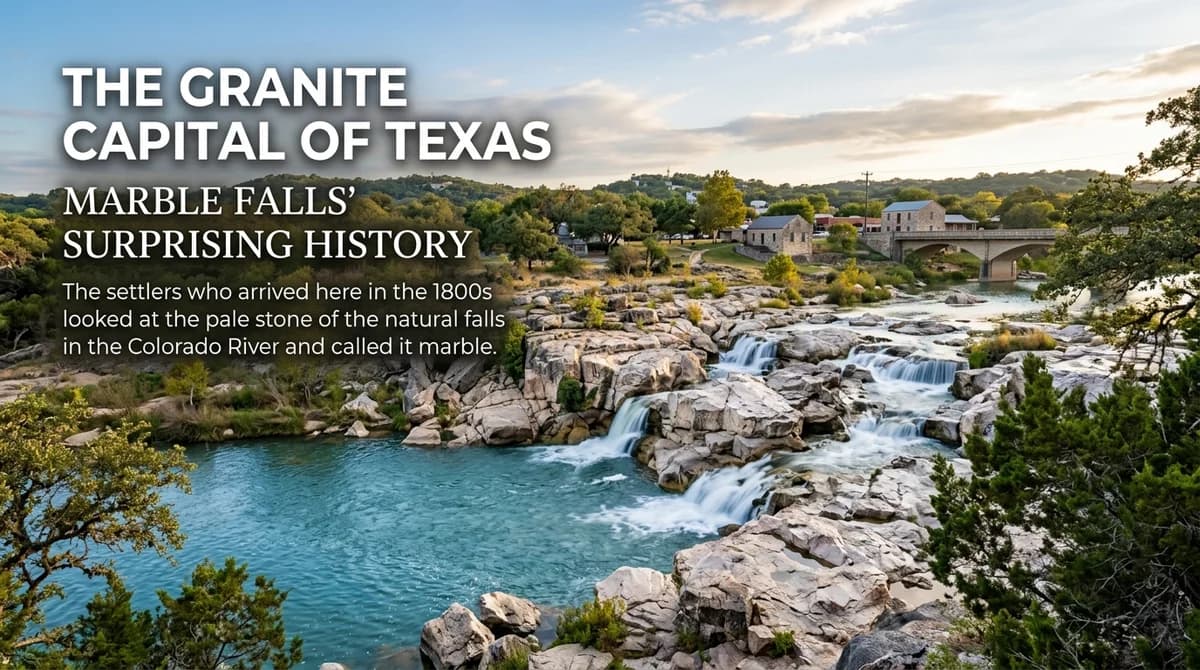
The settlers who arrived here in the 1800s looked at the pale stone of the natural falls in the Colorado River and called it marble. They were wrong about the geology, but the name endured, and the rock they misidentified turned out to be something even more significant: the material that would build the Texas State Capitol and cement this corner of the Hill Country's place in Texas history forever.
This is the story of Marble Falls, the granite that built a state capitol, and the man who put it all in motion.
The Natural Falls and the First Settlers
Before there was a town, there were falls. The Colorado River, cutting through the Hill Country limestone and granite on its way southeast toward Austin, created a dramatic series of cascades over the pale stone of the riverbed — falls that early surveying parties noted in their maps and reports. The stone they saw was actually granite, but in the uncertain light of the 1830s and 40s, it looked close enough to marble that the name stuck.
The falls were a landmark in the Hill Country landscape long before anyone thought about building a town near them. Native Americans, Spanish explorers, and the early Anglo and German settlers who began moving into the region all knew of them. Their practical significance — as a point where the river was shallow enough to cross, where the water was accessible — made them a natural gathering point.
Adam Rankin "Stovepipe" Johnson and the Founding of Marble Falls
The town of Marble Falls owes its existence to one of the more colorful characters in Texas history: Adam Rankin Johnson, known universally as "Stovepipe" for reasons that vary depending on who tells the story.
Johnson had first surveyed the Marble Falls area in the 1850s, when he worked as a Burnet County surveyor and came to know this part of the Hill Country intimately. He served as a Confederate general during the Civil War — a brilliant guerrilla leader who led raids across the Kentucky border — and was blinded in both eyes during a tragic friendly fire incident in 1864. Despite his blindness, Johnson remained an energetic and ambitious man in the decades after the war.
In the early 1880s, Johnson returned to the Marble Falls area with a vision. He saw the potential of Granite Mountain — the enormous dome of pink granite sitting just west of the natural falls — as a commercial resource, and he understood that extracting and transporting that granite required a railroad. He set about making both happen.
The Granite That Built the Texas Capitol
The story of how Marble Falls granite ended up in the Texas State Capitol is one of the better deals in Texas history — for Texas, at least.
In 1882, the Texas Legislature authorized the construction of a new state capitol building in Austin. The building was to be monumental in scale — designed to be the largest state capitol in the country — and required an extraordinary quantity of building material. The original specifications called for Indiana limestone, but that plan changed when the situation around Granite Mountain became known.
In 1885, the town of Marble Falls made an offer to the Capitol commissioners: they would donate their granite for the construction of the Capitol in exchange for a railroad and the labor necessary to quarry and transport the stone. The offer was accepted.
What followed was one of the largest construction supply operations in 19th-century Texas. Workers — many of them convict laborers and Scottish stonemason immigrants — quarried the pink granite from Granite Mountain and loaded it onto railcars for the trip to Austin. The granite was officially designated "Sunset Red" for the Capitol project, though locals have always called it by its more descriptive common name: the same pink granite you see at Inks Lake State Park and throughout the Hill Country geology.
In total, 15,700 carloads of granite made the journey from Marble Falls to Austin. The Texas State Capitol was completed in 1888, and at the time of its completion it was described as the seventh-largest building in the world. Today it remains the largest state capitol building in the United States, taller than the U.S. Capitol in Washington, D.C.
Standing at the base of the Texas State Capitol and looking up at the pink stone — the same pink as the outcrops at Inks Lake, the same pink as the boulders that line the Hill Country roads around Marble Falls — is one of those moments where Texas history becomes tangible rather than just printed on a page.
Granite Mountain Today
Granite Mountain is still there, still pink, still visible from the highway west of town. Although quarrying operations have changed over the decades, the mountain has been continuously mined for granite since the Capitol project, making it one of the longest-running active quarry operations in Texas.
The "Sunset Red" granite of Marble Falls is still considered a premium building and countertop material, and stone from Granite Mountain continues to appear in construction projects across Texas and beyond. The Capitol connection gives Marble Falls granite a provenance and prestige that few building materials can match — when you put Marble Falls granite in a building, you're using the same material that built the seat of Texas government.
The mountain is on private property and not publicly accessible for recreation, but it's visible from the road and easy to appreciate from a distance. The scale of it — a solid dome of bare pink granite rising steeply above the surrounding terrain — gives you an immediate sense of why it caught Adam Rankin Johnson's entrepreneurial eye.
The Falls That Aren't There Anymore
Here's the irony at the heart of Marble Falls' history: the falls that gave the town its name no longer exist.
When the Lower Colorado River Authority built a series of dams along the Colorado River between 1937 and 1951, the resulting chain of reservoirs submerged much of the river's natural character — including the natural marble falls themselves. The falls that Adam Rankin Johnson first saw when he surveyed this area in the 1850s, the falls that gave the town its evocative if geologically inaccurate name, are now under 30 feet of water at the lower end of Lake Marble Falls.
The creation of the Highland Lakes was an enormous economic and recreational boon to the region — the six reservoirs transformed a remote Hill Country river valley into one of Texas's premier lake destinations and provided flood control, hydroelectric power, and water supply for the growing region. But the price of that transformation included the submersion of the natural landscape features that gave places like Marble Falls their original identity.
The town kept its name, of course. And the granite mountain that was always the more significant geological feature of the area still stands, still producing stone, still connecting this corner of the Hill Country to the Texas Capitol whose pink walls it built.
Johnson City and the Broader Hill Country Historical Context
The Marble Falls area sits in a region extraordinarily rich in Texas history. Johnson City, named for Adam Rankin Johnson's family, is about 30 miles east. Burnet, the Burnet County seat 14 miles north, was a key supply point during the frontier era. The entire Highland Lakes region was shaped by decisions made in Austin — about dams, about water rights, about the Colorado River's management — that transformed a wild frontier landscape into the recreational and residential environment it is today.
Longhorn Cavern State Park, just north of Marble Falls, adds another historical layer: the cave was used by Native Americans for thousands of years, served as a gunpowder manufacturing site during the Civil War, and was developed as a tourist attraction in the 1930s with Civilian Conservation Corps labor. Each of these layers — Native American use, frontier settlement, Confederate military history, Depression-era development, postwar lake creation — sits atop the geological history that Granite Mountain represents.
The Legacy in the Landscape
What makes Marble Falls unusual as a Texas small town is that its most significant historical contribution is something visitors encounter constantly without necessarily knowing it. Every Texan who has ever set foot in the State Capitol has stood in a building partly shaped by this small Hill Country town's granite. Every visitor to Inks Lake who has admired the pink outcrops has seen the same geological formation that built one of the great monuments of Texas civic architecture.
The history of Marble Falls is literally in the stone. It's in the Capitol building in Austin, it's in the mountain west of town, and it's in the outcrops that line the Highland Lakes and the roadcuts that expose the Hill Country's ancient interior. That's a more permanent and pervasive historical legacy than most towns anywhere in the country can claim.
The falls are gone. But the granite endures. In the Texas State Capitol and in every pink boulder along the lakeshore, Marble Falls has left its mark on Texas in a way that will outlast any of the humans who first gave it a name.