
 LoneStar Network Staff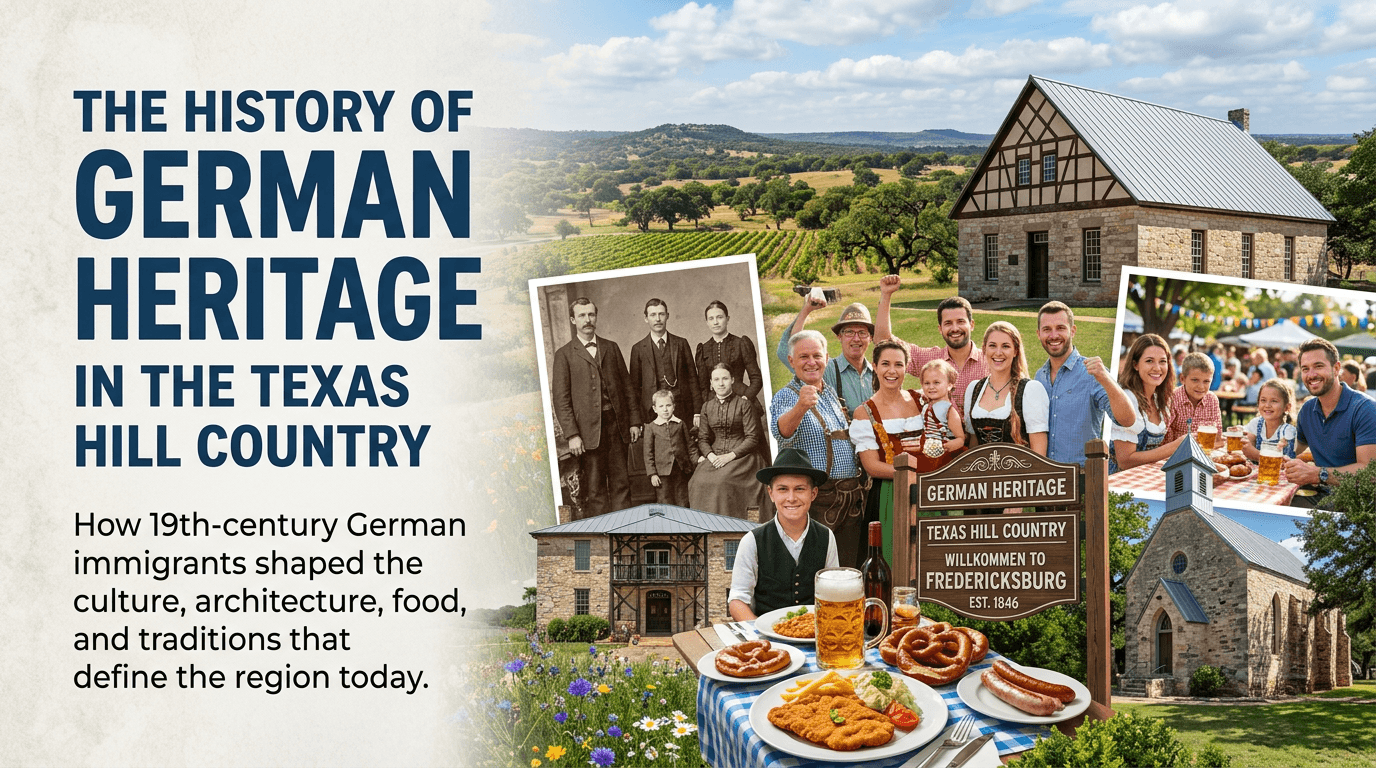
The Texas Hill Country looks and feels distinctly different from other Texas regions, and that difference begins with understanding German immigration. Beginning in the 1830s and accelerating through the 1880s, German immigrants fundamentally transformed the Hill Country—culturally, economically, architecturally, and spiritually.
Today, you can't walk through Fredericksburg's Main Street, enjoy a German-style Sunday dinner, or appreciate the region's stone architecture without understanding German heritage. This heritage isn't historical background—it's woven into the fabric of contemporary Hill Country life.
Why Germans Came to Texas
The story of German immigration to the Hill Country begins with political upheaval and economic hardship in 1830s-1840s Germany. After failed revolutions in 1848-1849, many Germans fled political repression, military service obligations, and limited economic opportunity.
Texas, still an independent republic and newly joined state, represented opportunity. The Texas government offered favorable land policies: settlers could purchase land at low prices and sometimes receive grants. Unlike some American destinations requiring capital investment, Texas offered hope for relatively poor Europeans.
German immigrants organized through settlement societies and collective immigration movements. Instead of individuals scattered across America, German families and entire village groups relocated to Texas as communities. This communal approach preserved German language, culture, and traditions in ways that isolated immigrants couldn't maintain.
The First Wave: German Settlements in the 1830s-1840s
The earliest German settlements in Texas weren't in the Hill Country but in coastal areas near Galveston. However, by the 1840s, as German population increased, settlers moved inland seeking better agricultural land and establishing new communities.
Johann Stieler, a key figure in German immigration movement, helped organize the Adelsverein (Society for the Protection of German Immigrants in Texas), which coordinated large-scale immigration and settlement. The Adelsverein purchased land in the Hill Country and organized the settlement of what became Fredericksburg in 1846.
The early Hill Country Germans faced immediate challenges: distance from supply sources, hostile Native American encounters, inadequate initial infrastructure, and crop failures. Yet these communities persisted, establishing permanent settlements through persistence and cultural cohesion.
Fredericksburg: The Heart of German Hill Country
Fredericksburg, founded in 1846, represents the heart of German Hill Country heritage. Named after Prince Frederick of Prussia, the town was established by 120 German families organized by the Adelsverein.
The town's original layout reflected German planning principles: wide Main Street designed to accommodate cattle drives and commerce, a central market square concept, and lots sized for family farms and businesses. The street plan remains largely unchanged, giving modern Fredericksburg its distinctive character.
Early Fredericksburg residents replicated German architectural styles and building techniques. They constructed their stone buildings using limestone, the abundant local material, creating the distinctive aesthetic that characterizes historic Fredericksburg today.
The town charter itself reflected German values: provisions for schools, churches, and community institutions appeared alongside commercial concerns. This emphasis on education and cultural preservation influenced Fredericksburg's development from the beginning.
German Settlements Beyond Fredericksburg
While Fredericksburg dominates the German heritage narrative, other Hill Country communities also reflect German settlement:
Blanco received German settlers by the 1870s, though it was established earlier by Anglo settlers. German families established themselves throughout Blanco County.
Boerne (originally spelled "Boerne's Prairie," named for Ludwig Boerne, a German author) became another center of German settlement in the Hill Country's southern region.
Johnson City and other smaller Hill Country towns also incorporated German immigrants into their communities, though they weren't exclusively German settlements.
Stonewall, established as a German settlement in 1888, represents a later wave of German immigration. The community developed around German farmers and ranchers.
These settlements, while less dramatically German than Fredericksburg, incorporated German cultural elements into local life.
Language: The Most Visible Cultural Marker
German language preservation was crucial to immigrant communities. For the first few generations, German was the primary language in homes, churches, and community spaces. German-language schools educated children, maintaining linguistic traditions.
This language preservation wasn't passive—communities actively chose to maintain German despite pressure to assimilate. German-language newspapers served Hill Country communities well into the 20th century.
However, World War I created a dramatic shift. Anti-German sentiment swept across America, including Texas. German language instruction was banned in public schools. German-language publications ceased. Speaking German in public became socially risky.
By the 1920s, English had become the primary language for German-heritage communities, though German remained spoken in homes and family contexts. Today, while conversational German has largely disappeared, place names, family names, and cultural memory preserve linguistic heritage.
Architecture: German Building Traditions in Stone
The most visible German heritage in the Hill Country is architectural. Early German settlers brought building techniques, aesthetic preferences, and structural innovations that created a distinctive regional architectural style.
Stone Construction: German settlers quickly realized that limestone, abundant in the Hill Country, made superior building material. They developed quarrying and stone-working techniques, creating buildings designed to last centuries.
Stone buildings offer practical advantages: they're fireproof, temperature-insulated, and durable. But they also reflect German aesthetic preferences and craftsmanship traditions. German stonemasons took pride in their work, visible in decorative details and precise construction.
Architectural Features:
- Thick stone walls for insulation
- Pitched roofs designed for European climate (surprisingly effective even in Texas)
- Deep porches and covered entryways
- Window placement emphasizing efficiency and protection
- Interior room arrangements reflecting German family life and space usage
Walk through historic Fredericksburg, Boerne, or Blanco, and you'll see buildings bearing names of German masons and construction dates from the 1870s-1890s. Many remain in use, testament to German building quality.
The Fachwerkhaus: Some Hill Country buildings employed half-timbering (Fachwerkhaus), a traditional German building technique. These structures feature exposed wooden frames with stone or adobe infill. While less common than pure stone construction, examples exist throughout the region.
Food: German Culinary Traditions
German cuisine remains deeply embedded in Hill Country food culture. Many dishes that Hill Country residents consider traditional actually reflect German immigrant traditions.
Wursts and Sausages: German sausage-making traditions transformed Hill Country food culture. German settlers brought sausage recipes and expertise, establishing meat-processing traditions that persist today.
Several Hill Country businesses maintain German sausage traditions: Eckert's Meat Market (Fredericksburg) and other butcher shops still produce German-style sausages and processed meats using recipes from generations of immigrant families.
Bread and Baked Goods: German bakery traditions produced distinctive bread styles and baked goods. German whole-grain breads, ryes, and hearty loaves represented significant departures from Anglo-American white bread cultures.
Family recipes for German breads, strudels, and pastries remain within Hill Country German families, though fewer young people are learning these traditions.
Family Meals: The traditional German family dinner—featuring meat, potatoes, vegetables, and bread—became the Hill Country standard. Sunday dinners featuring roasted meats and root vegetables reflect German family meal traditions.
Beer Culture: Germans brought strong beer-drinking traditions and brewing knowledge. While Texas developed its own beer culture, German immigrants influenced regional preferences and consumption patterns.
Religion: Churches as Cultural Anchors
German churches served functions far beyond spiritual guidance—they became centers of community life, language preservation, and cultural identity.
St. Mary's Church (Fredericksburg), established in 1847, remains the dominant church in Fredericksburg. Built using local limestone, the church exemplifies German architectural and cultural values.
German Lutheran and Catholic churches established throughout the Hill Country served immigrant communities, conducting services in German and providing education and community support.
These churches maintained German language longer than secular institutions. German-language sermons, hymnals, and religious education preserved linguistic traditions and cultural connection to German heritage.
Today, many Hill Country churches continue honoring German heritage through specific worship traditions, annual German heritage celebrations, and commitment to preserving community history.
Community Life and Social Institutions
German settlers brought traditions of community cooperation and civic engagement:
School Systems: German immigrants established schools as community priorities, often before secular government education. This tradition of educational commitment influenced Hill Country development.
Community Celebration: German festival traditions created Hill Country events. German Oktoberfest traditions, Christmas celebrations, and harvest festivals became community events.
Mutual Aid Organizations: German communities established mutual aid societies and organizations providing financial assistance, health support, and community welfare. These traditions influenced Hill Country civic culture.
Cultural Preservation Through Festivals and Events
Modern Hill Country German heritage finds expression through cultural events:
Fredericksburg's Oktoberfest (October): A genuine celebration of German beer, food, and culture, not the commercialized version found in some American cities. German bands, traditional foods, authentic beer serve genuine community.
Boerne Berges Fest (August): A celebration of German culture including food, music, dance, and craft demonstrations.
German Heritage Festival Events: Various Hill Country communities host German cultural celebrations, particularly in spring and fall.
These events serve multiple purposes: celebrating heritage, maintaining cultural traditions, attracting tourism, and educating younger generations about German immigration.
The German Language Today
While fluent German speakers among German-heritage populations have declined dramatically, the language persists:
- Family names remain distinctly German (Mueller, Schmidt, Weber, Braun, Steinberg, etc.)
- Place names reflect German origins (Fredericksburg, Blanco, Boerne, Stonewall)
- Words and phrases persist in colloquial usage
- Cultural celebrations feature German language elements
- Some schools offer German language instruction
- Cultural organizations work to teach younger generations German heritage
Efforts to preserve German language knowledge exist: genealogy societies, cultural organizations, and some educational programs work to maintain connection to ancestral language.
German Heritage and Hill Country Identity
Understanding German heritage is crucial to understanding the Hill Country itself. The region's:
- Architecture: Reflects German building traditions and aesthetics
- Food culture: Maintains German culinary traditions and values
- Community values: Emphasize education, cooperation, and civic engagement
- Festival culture: Celebrates German traditions and immigrant heritage
- Agricultural practices: Many reflect German farming traditions
- Business ethics: Often reflect German values of quality craftsmanship and reliability
The Hill Country isn't the Hill Country without acknowledging German heritage's foundational role in creating regional culture.
Challenges to Heritage Preservation
Modern challenges threaten German heritage preservation:
Language Loss: As German-speaking generations pass away, conversational German knowledge disappears.
Commercial Exploitation: Some businesses market "German authenticity" in ways that oversimplify or distort cultural traditions.
Demographic Change: New residents and cultural diversity, while enriching, can dilute specific cultural traditions.
Modernization: Modern construction and development can erase physical reminders of German settlement and architecture.
Educational Gaps: Younger generations often lack knowledge of their German heritage.
Resources for Learning More
Fredericksburg Heritage Museum: Documents German immigration and settlement history with artifacts, documents, and cultural artifacts.
Adelsverein Archives: Research resources for German immigration history and genealogy.
Local Historical Societies: Blanco County Historical Society, Kendall County Historical Commission, and others preserve local German heritage history.
Genealogical Resources: German-heritage families can trace ancestry through genealogy societies and online resources.
Cultural Events: Participating in German heritage festivals and cultural celebrations provides lived experience of traditions.
Key Takeaways
- German immigration beginning in the 1830s-1840s fundamentally shaped Hill Country culture, architecture, and identity
- Fredericksburg, established in 1846 by German settlers, remains the heart of German Hill Country heritage
- Stone architecture reflects German building traditions and remains distinctive Hill Country characteristic
- German culinary traditions persist in Hill Country food culture through sausage-making, bread baking, and family meal traditions
- Churches served crucial roles in preserving German language and culture
- German heritage appears throughout contemporary Hill Country through place names, family names, architecture, and civic values
- Modern cultural events and heritage organizations work to preserve and celebrate German traditions
- Understanding German heritage is essential to understanding the Hill Country itself
Tags: German Heritage, History, Culture, Immigration, Fredericksburg, Architecture, Community