
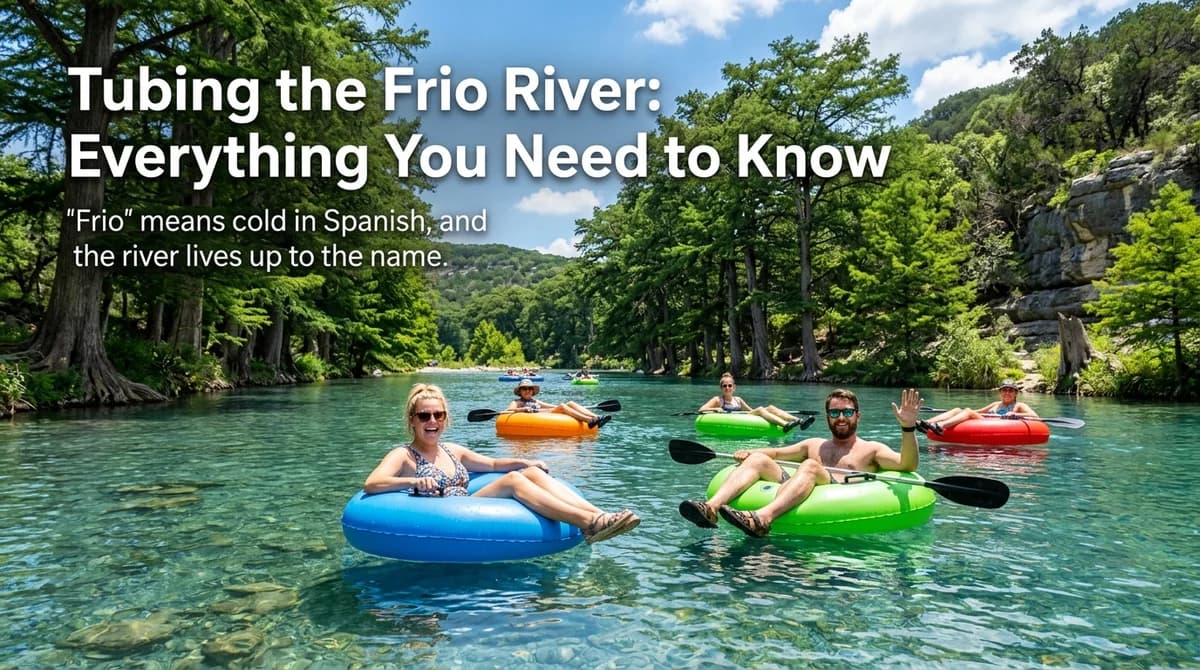
Ask a Texan who grew up going to Concan what the Frio River smells like and they'll probably tell you they don't know how to describe it, but they'd recognize it anywhere. Cold water, cypress, limestone, sunscreen — a combination so specific to a summer day on the Frio that it carries an entire childhood in it. Tubing the Frio is one of those experiences that Texas passes down through families the way other states pass down lake cabins or ski trips, and if you haven't done it, you're missing something that a significant slice of South and Central Texas considers a foundational summer ritual.
Here's everything you need to know to do it right.
What Makes the Frio Different
The Frio River's defining characteristic is its temperature. "Frio" means cold in Spanish, and the river lives up to the name — fed by springs from the Edwards Plateau, the water stays cold enough year-round to be a genuine shock when you first wade in, and genuinely refreshing when the air temperature is hovering at 100 degrees. This isn't the lukewarm river experience you get on slower, warmer Texas waterways. This is the kind of cold that makes you gasp, laugh, and immediately want to stay in.
The second characteristic is clarity. The Frio's limestone-filtered spring water is clear enough to watch fish move through the current, to see the patterns of rock and gravel on the bottom in the deeper pools, and to spot the aquatic life — bass, sunfish, small turtles — going about their business as you float overhead. On a sunny day, the light through the cypress trees onto the clear water creates a dappled, shifting brilliance that photographers have been trying to capture adequately for decades.
The third characteristic is the canopy. The bald cypress trees that line the Frio's banks — massive, ancient trees with flared buttress roots gripping the limestone at the water's edge — provide shade over much of the river's popular tubing sections. In July, floating under a cypress canopy over cold spring water is about as pleasant as being outdoors in Texas gets.
The Outfitters: Who Rents Tubes and Where
Several outfitters operate along the Frio River near Concan, offering tube rentals, shuttle service, and access to the river's most popular float sections.
Josh's Frio River Outfitters is one of the best-known and longest-operating outfitters on the river, with a location at US-83 and FM-127 that puts it conveniently near the most popular tubing sections. Josh's rents tubes and provides shuttle service to move floaters from take-out points back to their cars. The outfitter also has maps of the river available — useful for first-timers who want to know what's coming up around each bend.
Happy Hollow Frio River Outfitters is another established option serving the Concan, Leakey, and Garner State Park corridor. Tube rentals run approximately $12 per tube per day (with a deposit). The Happy Hollow float route is one of the more popular established float routes on the Frio, covering a stretch that offers both calm pools and occasional mild riffles.
Andy's on River Road combines cabin rentals with tube and kayak rentals, making it a one-stop option for visitors staying on site.
Frio Country Resort and other larger lodging operations typically offer tube rentals or can direct guests to the nearest outfitters. If you're staying at a cabin or camp along the river, ask about tube access when you book — many properties have either direct river access or close relationships with nearby outfitters.
Garner State Park itself rents pedal boats and canoes through the park's concession operation, offering an alternative to tube-based floating. The park's stretch of river is one of the more beautiful on the Frio, and the pedal boats are particularly good for families with young children.
The Float: What to Expect
The Frio near Concan is not a whitewater river. In normal summer flows, the current is gentle — the kind of pace that lets you drift without paddling, have a conversation with whoever's floating beside you, and let the scenery unfold at its own speed. There are occasional stretches of faster water over rocky shallows, but nothing that requires paddling experience or technical skill.
The most popular float sections take roughly 1.5 to 3 hours depending on water levels and how much you linger at swimming holes. Higher spring flows move you along faster; lower late-summer flows mean more wading through shallow sections. Either way, the experience is pleasant.
What you'll pass: bald cypress trees whose roots form archways and chambers at the water's edge; smooth limestone ledges perfect for pulling your tube out and jumping or wading; pools of still, clear, cold water deep enough to swim; occasional views of the canyon walls above the river corridor; great blue herons in the shallows; and the general atmosphere of a river that has been doing this for a long time and has gotten very good at it.
Bring a cooler tube for drinks and snacks. Several outfitters rent "cooler tubes" — large inner tubes modified to hold a cooler — alongside the standard float tubes. A few cold drinks and simple snacks transform a float from a brief activity into an afternoon event.
Rules, Regulations, and River Etiquette
The Frio River has rules that are enforced, and knowing them before you show up avoids unpleasant surprises.
No glass containers on the river. Alcohol is allowed on many sections of the Frio, but it must be in cans only. No glass bottles, ever. The smooth limestone riverbed is where people are walking barefoot — broken glass in a river can cause serious injury and is essentially impossible to clean up completely.
No styrofoam coolers. Styrofoam breaks apart in water and distributes into fragments that are impossible to retrieve. Bring soft-sided or hard plastic coolers only.
Respect private property. Significant stretches of the Frio River corridor are bordered by private land. Using established access points and staying within the legal public water corridor is important — trespassing on riverside private property is a real legal issue and creates friction with the landowners who tolerate public river use.
Leave no trace. Pack out everything you pack in. The cleanliness of the Frio is a community value, and the river's clarity and quality are directly connected to whether the people who use it treat it with care.
Mind the current after rain. The Frio, like all Hill Country rivers, can rise dramatically and quickly after significant rainfall. Flash flood warnings in the area mean get out of the river immediately. A placid, knee-deep river can become a dangerous torrent within hours of a major storm upstream. Check weather forecasts before you float.
What to Bring
Water shoes or old sneakers. The riverbed is smooth limestone and gravel — comfortable enough for some bare feet, but much better navigated with footwear that can get wet. Sandals work but have a tendency to get sucked off in fast sections or stick in mud.
Waterproof bag or dry bag. Your phone, wallet, and keys need protection from the water. Waterproof pouches and dry bags are widely available and cost very little relative to the cost of a water-damaged phone.
Sunscreen, mineral-based and water-resistant. You are on a river in Texas in summer. The sun is relentless, the water reflects it, and you are exposed. Apply before entering, bring more for reapplication, and consider a long-sleeve sun shirt for extended float days.
Cash for outfitters. Many riverside outfitters operate on cash-first systems, particularly for smaller rentals and shuttle services. Having cash simplifies the transaction.
A hat. The cypress canopy provides some shade but not constant shade. A hat that can get wet and still function is worth having.
Snacks and drinks in cans. Bring more than you think you need. Floating in cold water on a hot day is surprisingly dehydrating, and a few hours on the river makes almost any food taste excellent.
Best Times to Float
Peak season: Memorial Day through Labor Day. The river is at its most festive and most crowded during this stretch. Summer weekends, particularly Saturday and Sunday, bring the largest crowds — parking at the popular access points fills up, the outfitters are busy, and the river itself has significant traffic. If you're planning a summer weekend trip, arrive early and have your parking and tube situation sorted before 10am.
Weekdays in summer are dramatically better than weekends. A Wednesday float in July, with a fraction of the crowd, the same cold water, and parking you can actually find, is the superior experience.
September and October are the Frio's best-kept secret. The summer crowds have mostly departed by Labor Day, but the river is still cold, the water levels are typically manageable, and the cypress trees begin their brief fall color change — turning a warm copper-gold that reflects beautifully off the water. A fall Frio float, with the canyon nearly to yourself and a cool morning bite in the air, is one of the better experiences the Texas Hill Country offers.
Spring (March–May) brings higher water levels and more current from winter rains, which can make for faster, more exciting floats — though very high water after a wet spring should be treated with respect. The wildflowers along the canyon roads are a bonus that summer visitors don't get.
After the Float
The Frio has a way of making you hungry. Neal's Dining Room, across Highway 127 from Neal's Lodges, has been feeding post-float visitors since the 1920s — the chicken-fried steak and the homemade pies are the things to order, and the setting has the kind of no-frills Texas authenticity that makes the food taste better than it needs to. The small camp stores along the river road stock ice, drinks, and the basics. Bring supplies from Uvalde or San Antonio for anything more than that.
The Frio's other gift is that after a day on the water, the evenings feel earned. The canyon cools faster than the surrounding hills once the sun drops, the stars are extraordinary without city light to compete with, and the sound of the river carries to the cabin porches and the campfire circles in a way that makes conversation slow and peaceful. It's what a summer day is supposed to feel like when it ends well.
That's the Frio. It's been this way for a long time, and it'll be this way long after this summer is over.