
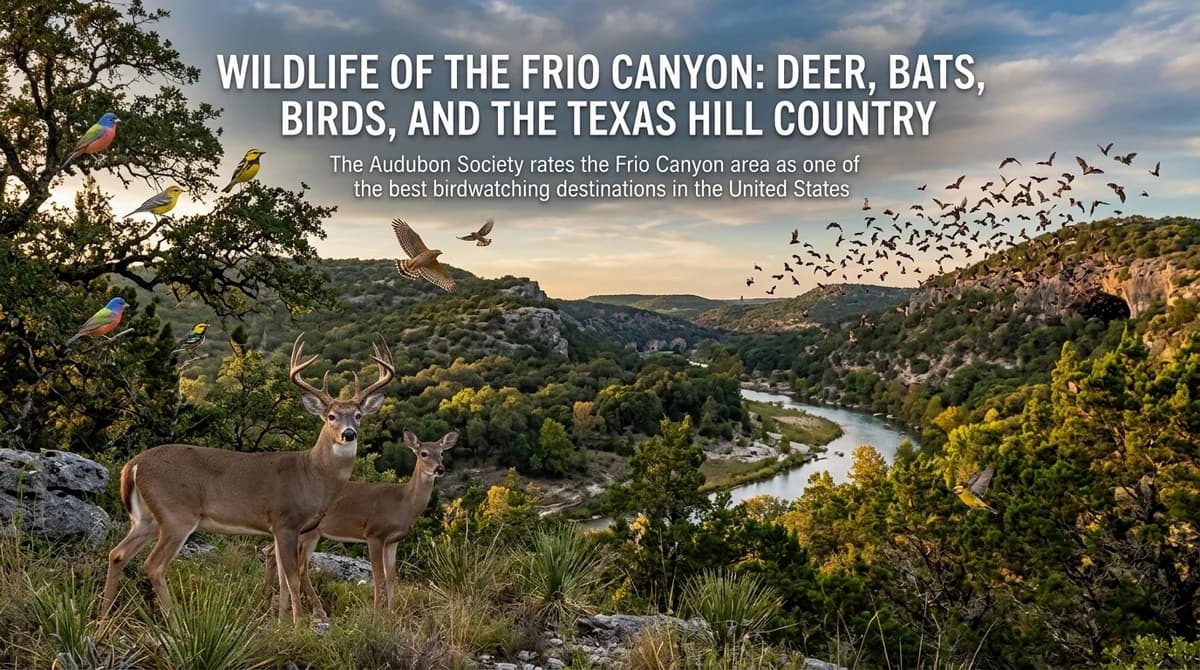
Most people who come to the Frio River come for the water. They leave having had wildlife encounters they weren't expecting — a white-tailed buck stepping out of the cedar at dusk, a painted bunting so vivid it seems impossible, a column of bats pouring out of a hillside cave in numbers that redefine what you thought "a lot of bats" meant. The Frio Canyon is, in addition to everything else it is, one of the more biologically interesting corners of Texas, and visitors who know what to look for find a dimension of the place that the tubing crowd mostly misses.
The Audubon Society rates the Frio Canyon area as one of the best birdwatching destinations in the United States — a designation that reflects the extraordinary combination of habitats this part of Texas provides. But even visitors who haven't touched a bird guide will find the wildlife here hard to miss, if they're paying any attention at all.
White-Tailed Deer
The white-tailed deer of the Texas Hill Country are among the most abundant and most photographed in the state, and the Frio Canyon is no exception. The combination of the river corridor's browse and water availability with the cedar and live oak woodland of the hillsides supports a healthy population that becomes visible to visitors who are simply outside at the right times.
Dawn and dusk are the productive hours. Deer move from the hillside woodland to the river for water in the early morning, and the return movement in the evening brings them through the same transition zones where they're most visible to people in the cabins and camps along the river road. A slow drive on the canyon roads at first light or in the hour before dark will almost always produce deer sightings.
The Hill Country deer tend to be smaller in body size than the deer of East Texas, reflecting the nutritional constraints of the limestone terrain — the limestone soils support less protein-rich vegetation than the more fertile soils of other regions. But the antlers of mature Hill Country bucks can be impressive, and during the rut in November and December, deer activity increases dramatically and unusual behavior — including bucks crossing roads in broad daylight — makes encounters more frequent and more dramatic.
The deer are genuinely wild animals, not habituated feeders, and their behavior reflects natural wariness. Getting close on foot requires patience and wind awareness. From a vehicle or a cabin porch, the distances are typically comfortable.
Wild Turkey
Wild turkeys are common throughout the Frio Canyon, often seen in groups moving along the woodland edges and the more open sections of the river corridor. The Tom Turkey's gobbling in spring is one of the canyon's distinctive sounds, carrying through the cedar woodland in the morning hours before the day warms up.
Turkeys are most visible in the early morning and late afternoon, typically in the same transition zones as deer — the edges between the denser woodland and the more open floodplain terrain where the riverbanks meet the hillside vegetation. A family group of turkey hens with poults (young birds) in late spring or early summer is one of the more charming wildlife encounters available in the canyon.
The Frio Bat Cave: 12 Million Mexican Free-Tailed Bats
The most dramatic wildlife experience available near Concan doesn't happen in the river or in the woodland — it happens at a hillside cave a few miles from the main lodging area where approximately 12 million Mexican free-tailed bats make their home from spring through early fall.
Twelve million is a number that requires context to appreciate. The emergence of a large bat colony begins with a trickle of individuals, then grows to a stream, then a river, then a sustained column pouring out of the cave entrance in a flow that continues for 20–30 minutes. The noise, the smell, and the sheer visual mass of the emergence are unlike anything most people have experienced, and even visitors who arrive with bat skepticism tend to leave converted.
The Mexican free-tailed bat is one of the most ecologically important animals in Texas. A single bat can consume its entire body weight in insects nightly — the 12 million bats at the Frio Bat Cave collectively consume an estimated 100 tons of insects each night during peak summer, providing agricultural pest control services whose value is measured in the millions of dollars annually.
The maternity colony at the Frio Bat Cave peaks in summer, when the females have given birth to their pups and the cave is at its most densely occupied. The emergence tours typically run from March through September. The cave is privately operated; check current tour availability and scheduling before visiting, as hours and access arrangements can change seasonally.
Practical notes for bat watching: Arrive before sunset, as the emergence timing varies with the season and weather. Bring insect repellent — ironic given what you're watching, but the area near the cave has its own insect population. Binoculars enhance the experience considerably. Children are often more captivated than adults expect them to be.
The Golden-Cheeked Warbler
Among the birding community, the Frio Canyon area is most significant for one bird: the golden-cheeked warbler. A small songbird with a striking combination of black and white plumage set off by brilliant yellow cheeks, the golden-cheeked warbler is the only bird species that nests exclusively in Texas — specifically in the mature Ashe juniper and live oak woodlands of the central Texas Hill Country.
The golden-cheeked warbler is federally listed as endangered, a status that reflects the loss of the mature cedar woodland habitat it requires for nesting. The male's distinctive "lazy daisy" song — a buzzy, rising-then-dropping phrase — is recognizable once you've heard it and becomes one of the most satisfying sounds in the canyon for people who know what it means.
Finding golden-cheeked warblers requires morning hours (they're most active and vocal before 10am), the right habitat (mature Ashe juniper with trees at least 15–20 years old), and some patience. The steep-sided hills above the Frio's main canyon, where mature cedar woodland has been relatively undisturbed, are the best areas to listen for them in April and May, their peak breeding season.
The Black-Capped Vireo
Sharing endangered status and Hill Country habitat with the golden-cheeked warbler, the black-capped vireo is a compact, energetic bird with striking black-and-white head patterning and olive-green back. It inhabits lower, scrubby vegetation — the shin oak and cedar shrublands at the bases of the canyon hillsides and in the more open, disturbed woodland edges.
The vireo's song — a persistently repeated series of two-note phrases that sounds more querulous and emphatic than melodic — is the easiest way to locate them once you know the sound. Males sing persistently through the breeding season from May through July, defending territories with a vocal persistence that makes them audible from significant distances.
The Painted Bunting
If the golden-cheeked warbler is the most ecologically significant bird of the Frio Canyon, the painted bunting is the most visually spectacular. The male painted bunting — deep cobalt blue head, brilliant red breast and rump, vivid lime-green back — is so intensely colored that it genuinely looks like a child's drawing of what a bird should look like rather than a real animal. First-time observers sometimes question whether what they're seeing is actually wild.
The painted bunting summers throughout the Frio Canyon and is most visible at feeders maintained by lodges and camps, where their visits to seed feeders in the mornings and evenings put them in plain view. The willingness to visit feeders makes painted buntings one of the most accessible of the Frio's spectacular birds — you don't need to hike anywhere to see one, just find a lodge or camp with well-maintained feeders and be present in the morning.
Female painted buntings are bright lime green — beautiful in their own right, though modest compared to the males. The combination of the male's colors and the female's subtle lime makes a mated pair at a feeder one of the more visually satisfying bird encounters available in the United States.
Hummingbirds
Several hummingbird species visit the Frio Canyon area during the migration periods and summer season. The ruby-throated hummingbird is the most common breeder in the eastern part of the range, but the canyon's position in central Texas means it receives visits from western species as well — black-chinned hummingbirds are summer residents throughout the Hill Country, and migrating rufous hummingbirds pass through in late summer and fall.
Feeders maintained at lodges and camps attract hummingbirds reliably, and the activity at a well-maintained feeder in the early morning — multiple species competing for access, the hovering and chasing and the astonishing aerial agility of these birds — is endlessly watchable.
Kingfishers and River Birds
The Frio River corridor is excellent habitat for water-associated birds, and the belted kingfisher is one of the most commonly observed year-round residents. The rattling call of a kingfisher making its way down the river, its distinctive large-headed silhouette visible from a distance, is part of the ambient soundtrack of any morning on the Frio.
Great blue herons are present throughout the year, standing motionless in the shallows or moving in their slow, deliberate stalking pattern along the river's edges. Green herons occupy the more densely vegetated sections of the bank. The rare cerulean or zone-tailed hawk might be seen soaring above the canyon on warm afternoons.
When and How to See Wildlife
Mornings and evenings are the productive times for most wildlife observation. The hours around dawn and the hour before dark bring deer, turkey, and most birds into their most active and visible phases. Midday, when the temperature peaks and the tubing crowds are at maximum density on the river, is the quietest time for wildlife activity.
Shoulder seasons offer better wildlife observation than peak summer. The crowds that come with summer weekends push wildlife to less disturbed areas, and the relative quiet of a September or October morning on the Frio produces wildlife encounters that a Fourth of July weekend simply doesn't.
Walk quietly. The canyon's wildlife is habituated to some human presence but is not habituated enough to ignore noise and sudden movement. Moving slowly and quietly along the river banks and woodland edges produces incomparably more sightings than the crashing approach that most visitors unconsciously take.
The Frio Canyon has always been more than a swimming hole. The wildlife makes sure of that, if you're paying attention.